


Page 19 - Thinking Critically
P. 19
20   T��n��n�� C��t���������


                             •   Evaluate, assess, defend, support: you will need to prepare a
                                 reasoned judgement based on your analysis.
                             •   Apply, demonstrate, illustrate, interpret, solve: you will need

                                 to apply the subject (to a given situation).
                             •   Develop, formulate, arrange: you are expected to combine the
                                 material with other materials you read in the course.
                             •   Compare, contrast, discriminate, distinguish, examine:: you
                                 will need to analyse the argument.
                             •   Define, list, name, order�: you will need to identify the content.you will need to identify the content.


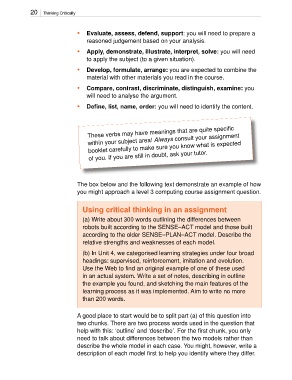
                                 These verbs may have meanings that are quite specific
                                 within your subject area! Always consult your assignment
                                 booklet carefully to make sure you know what is expected
                                  of you. If you are still in doubt, ask your tutor.


                             The box below and the following text demonstrate an example of how
                             you might approach a level 3 computing course assignment question.


                               Using critical thinking in an assignment
                               (a) Write about 300 words outlining the differences between
                               robots built according to the SENSE–ACT model and those built
                               according to the older SENSE–PLAN–ACT model. Describe the
                               relative strengths and weaknesses of each model.
                               (b) In Unit 4, we categorised learning strategies under four broad
                               headings: supervised, reinforcement, imitation and evolution.
                               Use the Web to find an original example of one of these used
                               in an actual system. Write a set of notes, describing in outline
                               the example you found, and sketching the main features of the
                               learning process as it was implemented. Aim to write no more
                               than 200 words.


                             A good place to start would be to split part (a) of this question into
                             two chunks. There are two process words used in the question that
                             help with this: ‘outline’ and ‘describe’. For the first chunk, you only
                             need to talk about differences between the two models rather than
                             describe the whole model in each case. You might, however, write a
                             description of each model first to help you identify where they differ.

