


Page 67 - BBC Wildlife Volume 36 #02
P. 67
Main image: Water
clarity was excellent,
showing in great detail
this humpback. Right:
Richard snorkels close
to a surfacing whale.
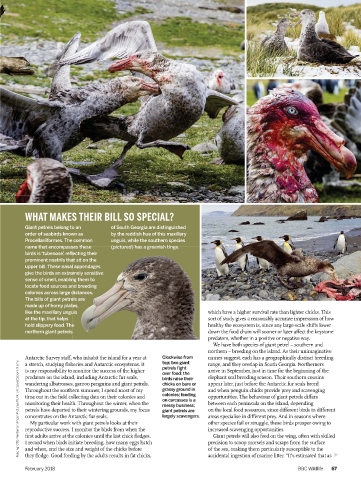
WHAT MAKES THEIR BILL SO SPECIAL?
Giant petrels belong to an of South Georgia are distinguished
order of seabirds known as by the reddish hue of this maxillary
Procellariiformes. The common unguis, while the southern species
(
ed
tur
pic
e
the
s
ses
) h
eenish
ing
t
e
as
r
a g
name that encompasses these (pictured) has a greenish tinge. .
flecting their
birds is ‘tubenose’, reflecting their
a
t sit on the
prominent nostrils that sit on the
s
ag
d
appen
l
e
upper bill. These nasal appendages
give the birds an extremely sensitive
emely sensitive
sense of smell, enabling them to
ng them to
d br
eeding
locate food sources and breeding
n
distances.
colonies across large distances.
The bills of giant petrels are
els are
tes,
made up of horny plates,
like the maxillary unguis which have a higher survival rate than lighter chicks. This
uis
at the tip, that helps sort of study gives a reasonably accurate impression of how
hold slippery food. The e healthy the ecosystem is, since any large-scale shifts lower
northern giant petrels s down the food chain will sooner or later affect the keystone
predators, whether in a positive or negative way.
We have both species of giant petrel – southern and
northern – breeding on the island. As their unimaginative
Antarctic Survey staff, who inhabit the island for a year at Clockwise from names suggest, each has a geographically distinct breeding
Feeding: Otto Plantema/Minden Pictures/FLPA; bill: David Osborn/Alamy wandering albatrosses, gentoo penguins and giant petrels. chicks on bare or appear later, just before the Antarctic fur seals breed
top: two giant
range, and they overlap in South Georgia. Northerners
a stretch, studying fisheries and Antarctic ecosystems. It
petrels fight
arrive in September, just in time for the beginning of the
is my responsibility to monitor the success of the higher
over food; the
elephant seal breeding season. Their southern cousins
predators on the island, including Antarctic fur seals,
birds raise their
grassy ground in
Throughout the southern summer, I spend most of my
and when penguin chicks provide prey and scavenging
colonies; feeding
opportunities. The behaviour of giant petrels differs
time out in the field collecting data on their colonies and
on carcasses is a
between each peninsula on the island, depending
monitoring their health. Throughout the winter, when the
messy business;
petrels have departed to their wintering grounds, my focus
on the local food resources, since different birds in different
giant petrels are
concentrates on the Antarctic fur seals.
areas specialise in different prey. And in seasons where
largely scavengers.
other species fail or struggle, these birds prosper owing to
My particular work with giant petrels looks at their
reproductive success. I monitor the birds from when the
increased scavenging opportunities.
first adults arrive at the colonies until the last chick fledges.
Giant petrels will also feed on the wing, often with skilled
I record when birds initiate breeding, how many eggs hatch
of the sea, making them particularly susceptible to the
and when, and the size and weight of the chicks before
they fledge. Good feeding by the adults results in fat chicks,
accidental ingestion of marine litter. “It’s estimated that as
BBC Wildlife
February 2018 precision to scoop morsels and scraps from the surface 67

