


Page 70 - All About History - Issue 186-19
P. 70
he names Venus and Aphrodite
                           are synonymous with love, and
                           have been for centuries. Myths
                           are still told today of the goddess’s
                        nd of her adventures in antiquity. But
          beyond the tales of sex and depravity, underneath
          the marble statues and grand temples, lies a history
          of the deity that seems to have been forgotten.
            The many faces of Venus-Aphrodite are finally
          coming to the forefront in a new book by award-
          winning historian and writer Bettany Hughes.
          The goddess’s fascinating past in the Middle East,
          North Africa and even Britain is uncovered in
          Venus And Aphrodite, so we’ve sat down to talk
          with Bettany about how the Greeks and Romans
          venerated her, what happened to her in the
          Christian world, how 20th century suffragettes
          felt about her image, and more besides.


          Why did you choose to look into Venus-
          Aphrodite, and why did you decide to
          publish this book now?
          It’s something that I’ve been thinking about for
          a long time. When I was writing about Helen of
          Troy, I noticed that actually, although later Helen
          gets the blame in the Greek world, really it’s
          Aphrodite who is responsible for the Trojan War
          as she tempted Paris to fall in love with Helen and
          then tempted Helen to run away with Paris. I’ve
          always been interested in Aphrodite as an active
          agent as a goddess, and so I’ve been gathering
          material since then.
            For a few years now it has felt like the right
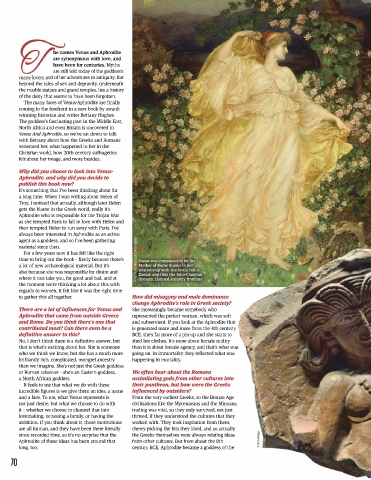
          time to bring out the book – firstly because there’s    Image source: wiki/Google Cultural Institute  Venus was considered to be the
          a lot of new archaeological material. But it’s            Mother of Rome thanks to her
          also because she was responsible for desire and           relationship with Anchises. Julius
                                                                    Caesar, and thus the Julio-Claudian
          where it can take you, for good and bad, and at           dynasty, claimed ancestry from her
          the moment we’re thinking a lot about this with
          regards to women. It felt like it was the right time
          to gather this all together.                          How did misogyny and male dominance
                                                                change Aphrodite’s role in Greek society?
          There are a lot of influences for Venus and           She increasingly became somebody who
          Aphrodite that came from outside Greece               represented the perfect woman, which was soft
          and Rome. Do you think there’s one that               and subservient. If you look at the Aphrodite th
          contributed most? Can there even be a                 is generated more and more from the 4th centur
          definitive answer to this?                            BCE, she’s far more of a pin-up and she starts to
          No, I don’t think there is a definitive answer, but   shed her clothes. It’s more about female nudity
          that is what’s exciting about her. She is someone     than it is about female agency, and that’s what w s
          who we think we know, but she has a much more         going on. In immortality they reflected what was
          brilliantly rich, complicated, mongrel ancestry       happening in mortality.
          than we imagine. She’s not just the Greek goddess
          or Roman takeover – she’s an Eastern goddess,         We often hear about the Romans
          a North African goddess.                              assimilating gods from other cultures into
            It feels to me that what we do with these           their pantheon, but how were the Greeks
          incredible figures is we give them an idea, a name    influenced by outsiders?
          and a face. To me, what Venus represents is           From the very earliest Greeks, so the Bronze Age
          not just desire, but what we choose to do with        civilisations like the Mycenaeans and the Minoans,
          it – whether we choose to channel that into           trading was vital, so they only survived, not just
          lovemaking, or raising a family, or having the        thrived, if they understood the cultures that they
          ambition. If you think about it, those motivations    worked with. They took inspiration from them,
          are all human, and they have been there literally     cherry-picking the bits they liked, and so actually
          since recorded time, so it’s no surprise that the     the Greeks themselves were always relating ideas
          Aphrodite of these ideas has been around that         from other cultures. But from about the 8th                  © Getty Images
          long, too.                                            century BCE, Aphrodite became a goddess of the

      70

