


Page 103 - (DK Eyewitness) Travel Guide - Germany
P. 103
FUR THER AFIELD 101
French-style Baroque garden, The collection is now housed in of these buildings remains. The
created to a strict geometrical the rebuilt Neues Museum on oldest part is the Funkturm and
design with a vibrant patchwork Museum Island (see p79). the pavilions surrounding it.
of flower beds, manicured shrubs The building at the front
and ornate fountains with replicas 5 Schloß (Ehrenhalle) was built in 1936 to
of antique sculptures. Beyond the a design by Richard Ermisch,
curved carp lake is a less formal Charlottenburg and is one of the few surviving
English-style landscaped park, See pp102–3. buildings in Berlin designed
originally laid out between 1819 in a Fascist architectural style.
and 1828 under the direction of The straight motorway at
the renowned royal gardener, the rear of the halls is the
Peter Joseph Lenné. famous Avus, the first German
Designed by Karl Friedrich autobahn, built in 1921. At one
Schinkel and completed in 1825, point adapted as a car-racing
the Neo-Classical Neuer Pavillon track, it now forms part of the
is a charming two-storey building autobahn system.
with rooms around a central
staircase. A cast-iron balcony
encircles the structure. Destroyed 7 Olympiastadion
in World War II, parts of the Olympischer Platz. s & Olympia-
building were rebuilt in 1970. Stadion. Tel (030) 30 68 81 00.
Since then it has housed Open late Mar–May: 9am–7pm daily;
Romantic paintings, including Jun–mid-Sep: 9am–8pm daily;
masterpieces by Caspar David mid-Sep–Oct: 9–7pm daily; Nov–late
Friedrich, Carl Blechen, Schinkel Mar: 9am–4pm daily. 7 &
and Eduard Gaertner. ∑ olympiastadion-berlin.de
The Mausoleum in which
Queen Luise, wife of Friedrich Olympiastadion, originally
Wilhelm III, was laid to rest, was known as Reichssportfeld,
designed by Heinrich Genz in the was built for the 1936 Olympic
style of a Doric portico-fronted Games in Berlin. It was designed
temple. After the king’s death in by Werner March in the Nazi
1840, the mausoleum was architectural style and was
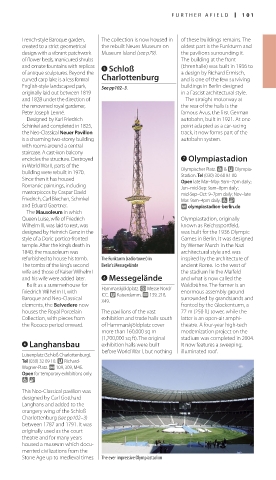
refurbished to house his tomb. The Funkturm (radio tower) in inspired by the architecture of
The tombs of the king’s second Berlin’s Messegelände ancient Rome. To the west of
wife and those of Kaiser Wilhelm I the stadium lie the Maifeld
and his wife were added later. 6 Messegelände and what is now called the
Built as a summerhouse for Hammarskjöldplatz. Messe Nord/ Waldbühne. The former is an
Friedrich Wilhelm II, with ICC. Kaiserdamm. @ 139, 218, enormous assembly ground
Baroque and Neo-Classical X49. surrounded by grandstands and
elements, the Belvedere now fronted by the Glockenturm, a
houses the Royal Porcelain The pavilions of the vast 77 m (250 ft) tower, while the
Collection, with pieces from exhibition and trade halls south latter is an open-air amphi-
the Rococo period onward. of Hammarskjöldplatz cover theatre. A four-year high-tech
more than 160,000 sq m modernization project on the
(1,700,000 sq ft). The original stadium was completed in 2004.
4 Langhansbau exhibition halls were built It now features a sweeping,
before World War I, but nothing illuminated roof.
Luisenplatz (Schloß Charlottenburg).
Tel (030) 32 09 10. Richard-
Wagner-Platz. @ 109, 309, M45.
Open for temporary exhibitions only.
7 &
This Neo-Classical pavilion was
designed by Carl Gotthard
Langhans and added to the
orangery wing of the Schloß
Charlottenburg (see pp102–3)
between 1787 and 1791. It was
originally used as the court
theatre and for many years
housed a museum which docu-
mented civilizations from the
Stone Age up to medieval times. The ever impressive Olympiastadion
100-101_EW_Germany.indd 101 09/10/17 12:46 pm

