


Page 111 - (DK Eyewitness) Travel Guide - Germany
P. 111
FUR THER AFIELD 109
Kunckel, an alchemist who lived l Klein Glienicke
on Pfaueninsel in the 17th Königstraße 36. @ 316. Tel (030) 805
century. During his quest to 867 510. Open Apr–Oct: 10am–6pm
discover how to make gold, Tue–Sun; Nov–Dec & Mar: 10am–5pm
he discovered a method of Sat & Sun. Closed Jan–Feb. &
producing ruby-coloured glass.
Near the Aviary, home to The palace in the palace-park of
multicoloured parrots and Klein Glienicke was built in
pheasants, is a tall fountain 1825–7 to a design by Karl
that was designed by Martin Friedrich Schinkel for Prince Karl
Friedrich Rabe in 1824. of Prussia. The charming park in
which it is located was created
by Peter Joseph Lenné. Beyond
k Nikolskoe the Neo-Classical palace consists
The Schloß Pfaueninsel designed by Nikolskoer Weg. Wannsee, then of an irregular cluster of buildings,
Johann Brendel grouped around a courtyard,
take @ 316.
including the pergola, the stable
j Pfaueninsel Across the river from and the tower. Passing by the
Pfaueninsel (Peacock Island) palace, you approach the Coach
Pfaueninsel. Tel (030) 805 86 830.
Wannsee, then take @ 218. is Nikolskoe. Here you’ll find House, also by Schinkel and
g Schloß Pfaueninsel. Open Apr– the Blockhaus now housing a
Oct: 10am–5:30pm Tue–Sun. & Nikolskoe, a restaurant. Nearby
Russian-style dacha are an orangery
This picturesque island, named (country house) and greenhouses
for the peacocks that inhabit it, that was built in designed by
is now a nature reserve, reached 1819 for the future Ludwig Persius.
by ferry across the Havel river. It Tsar Nicholas I The Klosterhof,
was laid out in 1795 according and his wife, the thought to be by
to a design by Johann August daughter of King Ferdinand von
Eyserbeck. Its final form, which Friedrich Wilhelm III. Arnim, is a mock
you see today, is the work of the The house was monastery with a
landscape architect Peter built by the cloister and two
Joseph Lenné. German military chambers and
One of the most interesting architect Captain Guests on the terrace of the many Byzantine
sights on the island is the small Snethlage, who Blockhaus Nikolskoe in summer and Roman esque
romantic palace of Schloß was responsible for architectural
Pfaueninsel. Dating from 1794, the Alexandrowka estate in elements from Italy. Towards the
it was designed by Johann Potsdam (see p138). Following lake is the Große Neugierde, a
Gottlieb Brendel for Friedrich a fire in 1985, the dacha was circular pavilion based on the
Wilhelm II and his mistress reconstructed. It currently Athenian monument to
Wilhelmine Encke (the future houses a restaurant. Lysikrates from the 4th century
Countess Lichtenau). The Close by is the church of St BC. From here there are
palace was built of wood, with Peter and Paul, which was built beautiful views across the Havel
a façade fashioned in the form between 1834 and 1837, to a river and Glienicker Brücke
of a ruined medieval castle. The design by Friedrich August (known under the East German
cast-iron bridge that links the Stüler. The body of the church is regime as the bridge of unity).
towers was built in 1807. The completed by a tower crowned The border with West Berlin ran
palace is open to the public by an onion-shaped dome, across this bridge where, during
in the summer months, when reflecting the style of Russian the Cold War, the exchange of
you can see the 18th- and Orthodox sacral architecture. spies was conducted.
19th-century furnishings.
Other sights worth visiting
include Jakobsbrunnen
(Jacob’s Well), which was built
to resemble an ancient ruin.
Towards the northeast corner of
the island is the Luisentempel
in the form of a Greek temple.
Its sandstone portico was
relocated to the island from
the mausoleum in Schloßpark
Charlottenburg (see pp102–3)
in 1829. Nearby is a stone
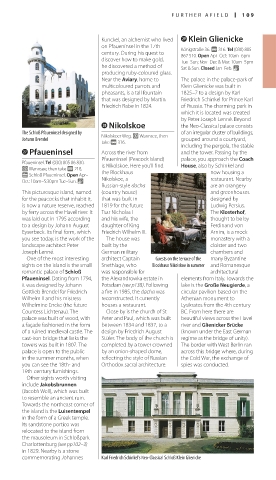
commemorating Johannes Karl Friedrich Schinkel’s Neo-Classical Schloß Klein Glienicke
108-109_EW_Germany.indd 109 09/10/17 12:46 pm

