


Page 159 - (DK Eyewitness) Travel Guide - Germany
P. 159
SA X ON Y–ANHAL T 157
q Stendal the Hamburg workshop of
Hans Scherer the Younger,
Road map D3. * 39,600. £ @
n Markt 1 (0393165 11 92). the 1619 pulpit created by
_ Rolandfest (early Jul). Christopher Dehne and a font
∑ stendal.de dating from 1508, the work
of Heinrich Mente.
In medieval times Stendal was The east wing of the beau tiful
one of the richest towns of the Gothic Rathaus (town hall)
Brandenburg margravate, and dates back to 1430 and is the
its most valuable historical work of Heinrich Brunsberg, its
remains date from that period. richly ornamented spire being
The lateGothic St Nikolai typical of his work. The west
cathedral was built in 1423–67, wing with its arcades was
on the foundations of a added around 1480, and the
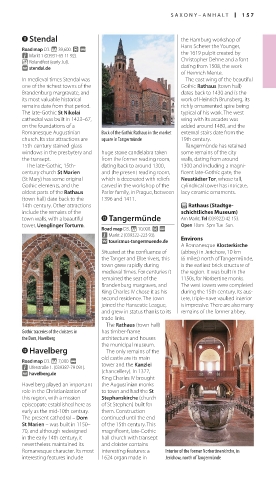
Romanesque Augustinian Back of the Gothic Rathaus in the market external stairs date from the
church. Its star attractions are square in Tangermünde 19th century.
15thcentury stainedglass Tangermünde has retained
windows in the presbytery and huge stone candelabra taken some remains of the city
the transept. from the former reading room, walls, dating from around
The lateGothic, 15th dating back to around 1300, 1300 and including a magni
cen tury church St Marien and the present reading room, ficent lateGothic gate, the
(St Mary) has some original which is decorated with reliefs Neustädter Tor, whose tall,
Gothic elements, and the carved in the workshop of the cylindrical tower has intricate,
oldest parts of the Rathaus Parler family, in Prague, between lacy ceramic ornaments.
(town hall) date back to the 1396 and 1411.
14th century. Other attractions P Rathaus (Stadtge
include the remains of the schichtliches Museum)
town walls, with a beautiful e Tangermünde Am Markt. Tel (039322) 42 153.
tower, Uenglinger Torturm. Open 10am–5pm Tue–Sun.
Road map D3. * 10,000. £ @
n Markt 2 (039322223 93).
∑ tourismus-tangermuende.de Environs
A Romanesque Klosterkirche
Situated at the confluence of (abbey) in Jerichow, 10 km
the Tanger and Elbe rivers, this (6 miles) north of Tangermünde,
town grew rapidly during is the earliest brick structure of
medieval times. For centuries it the region. It was built in the
remained the seat of the 1150s, for Norbertine monks.
Brandenburg margraves, and The west towers were completed
King Charles IV chose it as his during the 15th century. Its aus
second residence. The town tere, triplenave vaulted interior
joined the Hanseatic League, is impressive. There are also many
and grew in status thanks to its remains of the former abbey.
trade links.
The Rathaus (town hall)
Gothic traceries of the cloisters in has timberframe
the Dom, Havelberg architecture and houses
the municipal museum.
w Havelberg The only remains of the
old castle are its main
Road map D3. * 7,000. @
n Uferstraße 1. (03938779 091). tower and the Kanzlei
∑ havelberg.de (chancellery). In 1377,
King Charles IV brought
Havelberg played an important the Augustinian monks
role in the Christianization of to town and had the St
this region, with a mission Stephanskirche (church
episcopate established here as of St Stephen) built for
early as the mid10th century. them. Con struction
The present cathedral – Dom continued until the end
St Marien – was built in 1150– of the 15th century. This
70, and although redesigned magnificent, lateGothic
in the early 14th century, it hall church with transept
nevertheless maintained its and cloister contains
Romanesque character. Its most interesting features: a Interior of the former Norbertinenkirche, in
interesting features include 1624 organ made in Jerichow, north of Tangermünde
156-157_EW_Germany.indd 157 09/10/17 12:58 pm

