


Page 172 - (DK Eyewitness) Travel Guide - Germany
P. 172
170 EASTERN GERM AN Y SA X ON Y 171
9 Meissen
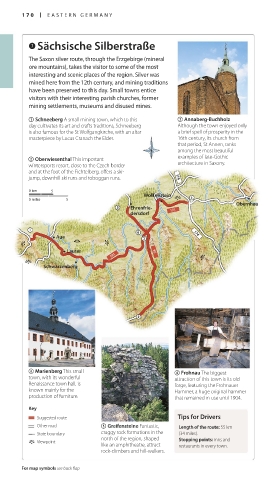
7 Sächsische Silberstraße
Road map 4E. & 36,000. £ @ n
The Saxon silver route, through the Erzgebirge (mineral Markt 3 (03521-419 40). _ Stadt- und
Weinfest (Sep). ∑ stadt-meissen.de
ore mountains), takes the visitor to some of the most
interesting and scenic places of the region. Silver was Meissen is famous for its
mined here from the 12th century, and mining traditions porcelain manufacture (see
pp128–9). Its history began in
have been preserved to this day. Small towns entice 929, when Henry I made it the
visitors with their interesting parish churches, former bridgehead for his expansion to
mining settlements, museums and disused mines. the east, into Slav territories. In
966 Meissen became the capital
1 Schneeberg A small mining town, which to this 3 Annaberg-Buchholz of the newly established
day cultivates its art and crafts traditions, Schneeberg Although the town enjoyed only Meissen margravate, and in
is also famous for the St Wolfgangkirche, with an altar a brief spell of prosperity in the 968 a bishopric. The Baroque hunting lodge in Moritzburg
masterpiece by Lucas Cranach the Elder. 16th century, its church from This town has retained much
that period, St Annen, ranks of its charm. In the town square showing historical scenes, are 0 Moritzburg
among the most beautiful is the late-Gothic Rathaus the work of Wilhelm Römann.
2 Oberwiesenthal This important examples of late-Gothic (town hall), built in 1472–8, The cathedral church of St John Road map 4E. £ n Schloßallee
3b (035207-85 40). _ Kammer-
wintersports resort, close to the Czech border architecture in Saxony. some beautiful Re naissance the Evangelist and St Donat, musikfestival (Aug); Fischzug (Oct).
and at the foot of the Fichtelberg, offers a ski- houses and the Frauenkirche, built from the mid-13th century
jump, downhill ski runs and toboggan runs. a late-Gothic, 15th-century to the early 15th century, has The first hunting lodge in
church boasting the world’s some splendid early-Gothic this marshy region was built
0 km 5 oldest porcelain carillon, which sculptures, an altar by Lucas in the mid-16th century, for
Wolkenstein
0 miles 5 was hung here in 1929. It is also Cranach the Elder in the Moritz of Saxony. The present
Obernhau
Ehrenfrie- worth taking a stroll to St Afra’s Georgskapelle and ducal tombs Schloß Moritzburg is the result
dersdorf church, built in the 13th century in the Fürstenkapelle. of extensive alterations ordered
for the Augustian monks. by Augustus the Strong,
P Staatliche Porzellan- directed by Matthäus Daniel
+ Albrechtsburg Manufaktur Pöppelmann, and carried out
Aue Domplatz 1. Tel (03521) 47 070. Talstraße 9. Tel (03521) 46 87 00. in 1723–26. The result is a
Open Mar–Oct: 10am–6pm daily; Open May–Oct: 9am–6pm daily; square building, with four
Lauter Nov–Feb: 10am–5pm daily. Nov–Apr: 9am–5pm daily. cylindrical corner towers. Much
Closed 24, 25, 31 Dec. & ∑ meissen.com of the interior has survived,
Schwarzenberg The Albrechtsburg is a vast, The first porcelain factory in including period furnishings
fortified hilltop complex with Europe was set up in 1710 in and hunting trophies.
a cathedral and an Elector’s the castle and moved to its Also open to visitors is the
palace. The latter was built in present premises in 1865. 17th-century castle chapel
1471–89 for the Wettin brothers, Documents relating to the decorated with splendid stucco
Ernst and Albrecht. Designed by history of the factory and many ornaments. Augustus the
Arnold von Westfalen, its special interesting examples of its Strong ordered the marshes
feature is the magnificent products are on display in to be drained, and the newly
external spiral staircase. From the exhibition rooms. Guided available land to be transformed
1710 the palace was used as a tours and demonstrations into landscaped gardens and
porcelain factory. It was restored take the visitor through all lakes. The Fasanenschlößchen
to its former glory in 1864. Huge the stages of the porcelain (little pheasant castle) in the
wall paintings of this period, manufacturing process. eastern part of the gardens
features several interesting
Rococo interiors, and also
houses a zoological exhibition.
6 Marienberg This small 4 Frohnau The biggest At the end of World War II,
town, with its wonderful attraction of this town is its old the German artist Käthe Kollwitz
Renaissance town hall, is forge, featuring the Frohnauer spent the last years of her life in
known mainly for the Hammer, a huge original hammer Moritzburg. The house in which
production of furniture. that remained in use until 1904. she lived and worked is now the
Käthe-Kollwitz-Gedenkstätte.
Key
Suggested route Tips for Drivers + Schloß Moritzburg
Other road 5 Greifensteine Fantastic, Length of the route: 55 km Tel (035207) 8730. Open Feb–Mar:
State boundary craggy rock formations in the (34 miles). 10am–4pm Sat & Sun; Apr–Oct:
10am–5:30pm daily; Nov–Dec:
north of the region, shaped Stopping points: inns and
Viewpoint 10am–4pm Tue–Sun. &
like an amphitheatre, attract restaurants in every town.
rock-climbers and hill-walkers. + Fasanenschlößchen
The late-Gothic Rathaus in Meissen Open as above. 8 compulsory.
For map symbols see back flap For hotels and restaurants in this area see p494 and pp514–16
170-171_EW_Germany.indd 170 09/10/17 12:49 pm 170-171_EW_Germany.indd 171 09/10/17 12:49 pm
Eyewitness Travel LAYERS PRINTED:
Catalogue template “UK” LAYER
(Source v2.3)
Date 6th February 2013
Size 125mm x 217mm

