


Page 180 - (DK Eyewitness) Travel Guide - Germany
P. 180
178 EASTERN GERM AN Y DRESDEN 179
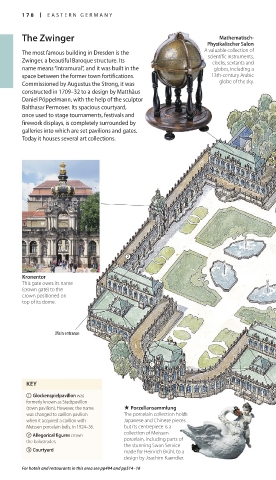
The Zwinger Mathematisch- VISITORS’ CHECKLIST
Physikalischer Salon
The most famous building in Dresden is the A valuable collection of Practical Information
scientific instruments,
Zwinger, a beautiful Baroque structure. Its clocks, sextants and Wallpavillon Sophienstraße/Ostra-Allee/
name means “intramural”, and it was built in the globes, including a A stunning marriage Theaterplatz. Porzellansammlung:
Tel (0351) 491 46612.
space between the former town fortifications. 13th-century Arabic of architecture and Open 10am–6pm Tue–Sun.
Commissioned by Augustus the Strong, it was globe of the sky. sculpture, this Baroque Mathematisch-Physikalischer
construc ted in 1709–32 to a design by Matthäus masterpiece is crowned Salon: Tel 491 46661.
by a statue of Hercules,
Daniel Pöppelmann, with the help of the sculptor symbolizing the Elector, Open 10am–6pm Tue–Sun.
∑ skd.museum
Balthasar Permoser. Its spacious courtyard, Augustus the Strong.
once used to stage tournaments, festivals and
firework displays, is completely surrounded by
galleries into which are set pavilions and gates.
Today it houses several art collections.
Galerie Alte Meister
Kronentor This gallery of old masters occupies
This gate owes its name the wing which was added by
(crown gate) to the Gottfried Semper (see pp180–81).
crown positioned on
top of its dome.
Main entrance
KEY
1 Glockenspielpavillon was
formerly known as Stadtpavillon
(town pavilion). However, the name . Porzellansammlung
was changed to carillon pavilion The porcelain collection holds
when it acquired a carillon with Japanese and Chinese pieces
Meissen porcelain bells, in 1924–36. but its centrepiece is a
2 Allegorical figures crown collection of Meissen
the balustrades. por celain, including parts of
the stunning Swan Service . Nymphenbad
3 Courtyard made for Heinrich Brühl, to a This fountain features tritons and nymphs, sculptures, and grottoes,
design by Joachim Kaendler. which were popular in the Baroque era.
For hotels and restaurants in this area see pp494 and pp514–16
178-179_EW_Germany.indd 178 09/10/17 12:49 pm 178-179_EW_Germany.indd 179 09/10/17 12:49 pm

