


Page 187 - (DK Eyewitness) Travel Guide - Germany
P. 187
SA X ON Y 185
of churches in Jerusalem. Görlitz Zittau Mountains, a paradise
still has remains of its medieval for rock-climbers, walkers and
town fortifications with original nature lovers. The town itself is
towers and gates, including the splendidly preserved, with many
Kaisertrutz, a 15th-century historic buildings, such as the
barbican, extended in the 19th beautiful, Baroque Noacksches
century and now home to the Haus (Markt 2). The Neo-
town’s art collection. Renaissance Rathaus (town
hall) was built in 1840–45,
Environs to a design by Carl Augustus
The small town of Ostritz, Schramm. The Johanniskirche,
16 km (10 miles) to the south, by Karl Friedrich Schinkel,
has a charming original combines elements of Neo-
Cistercian abbey, St Marien thal Classical and Neo-Gothic styles
(1230). Its red-and-white build- and is an excellent example of
ings are to this day inhabited by Historicist architecture.
Baroque Neptune fountain in Untermarkt, nuns, who show visitors around
in Görlitz and serve food and home- Environs
brewed beer. The charming spa town of
u Görlitz Oybin, 9 km (6 miles) south
of Zittau, can be reached by
Road map F4. * 66,000. £ @ i Zittau
n Obermarkt 32 (03581-475 70). narrow-gauge railway. Its
_ Kultursommer (May–Sep); Road map F4. * 28,000. £ @ attractions include the hilltop
Sommertheater (Jul); Strassen theater- n Markt 1 (03583-75 22 00). ruins of a Gothic abbey,
festival (Aug). ∑ goerlitz.de _ Klosterfest (Ascension) (May); Fest immortalized by Caspar David
am Dreiländereck (Jun); Stadtfest (Jul). Friedrich. It is worth timing your
This border town, whose eastern ∑ zittau.eu visit for a Saturday evening in
part, Zgorzelec, has belonged summer, when you can witness
to Poland since 1945, boasts a Zittau is an excellent starting the procession of torch-bearing
long history. Its oldest records point for excursions into the monks or listen to a concert.
date back to 1071. Founded in
1210–20, the town flourished
in the 15th and 16th centuries.
In 1990 an extensive restoration
plan was begun, and now visit-
ors can see its historic buildings
in their former glory.
The charming houses in
Obermarkt (upper market),
the Renaissance portals and
decorations on houses in
Brüderstraße and the fasci nating
Untermarkt (lower market),
with its vast town hall complex,
enchant everyone. The older
wing of the town hall, the work
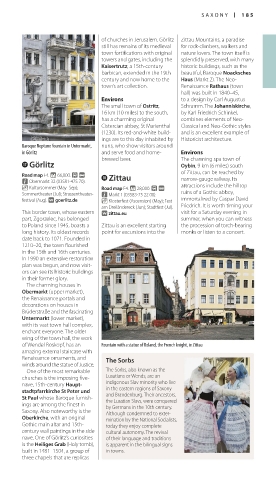
of Wendel Roskopf, has an Fountain with a statue of Roland, the French knight, in Zittau
amazing external staircase with
Renaissance ornaments, and The Sorbs
winds around the statue of Justice.
One of the most remarkable The Sorbs, also known as the
churches is the imposing five- Lusatians or Wends, are an
nave, 15th-century Haupt indigenous Slav minority who live
stadtpfarrkirche St Peter und in the eastern regions of Saxony
and Brandenburg. Their ancestors,
St Paul whose Baroque furnish- the Lusatian Slavs, were conquered
ings are among the finest in by Germans in the 10th century.
Saxony. Also noteworthy is the Although condemned to exter-
Oberkirche, with an original mination by the National Socialists,
Gothic main altar and 15th- today they enjoy complete
century wall paintings in the side cultural autonomy. The revival
nave. One of Görlitz’s curiosities of their language and traditions
is the Heiliges Grab (Holy tomb), is apparent in the bilingual signs
built in 1481–1504, a group of in towns.
three chapels that are replicas
184-185_EW_Germany.indd 185 09/10/17 12:59 pm

