


Page 218 - (DK Eyewitness) Travel Guide - Germany
P. 218
216 SOUTHERN GERM AN Y MUNICH 217
the church was consecrated 5 Deutsches represented in the museum’s
seven years later. The royal Jagd- und collection include several great
architect, Giovanni Antonio names such as Rubens, Snyders
Viscardi, assisted by Enrico Fischerei museum and Antonio Pisanello.
Zucalli and Georg Ettenhofer, German Museum of Hunting
created a building that is one of and Fishing
the most beautiful examples Neuhauser Straße 2. Map 2 A4. 6 Asamkirche
of Italian Baroque in Munich. Tel (089) 22 05 22. or Asams’ Church
The church’s original features Marienplatz. v 18, 19, 20, 21, 27. Sendlinger Straße 32. Map 2 A5.
include the dome fresco by Open 9:30am–5pm Mon–Wed & Fri– Sendlinger Tor. v 16, 17, 18, 27.
Cosmas Damian Asam, The Sun, 9:30am–9pm Thu. & @ 52, 152. Open 8am–7:30pm daily.
Adoration of the Trinity. 5 5pm Tue, Thu, Fri; 10am Sun.
Immediately adjacent to St 8 noon Sat (May–Sep).
Michael’s Church is the
4 Frauenkirche Augustinerkloster, the former Officially known as St Johann-
Augustinian church, which now Nepomuk, this gem of
Frauenplatz 1. Map 2 B4. Tel (089) 290
08 20 or Karlsplatz & Marien- houses the Museum of Hunting Rococo architecture stands in
platz. v 19. Church: Open and Fishing. The original building Sendlingerstraße and is part
7:30am–8pm daily (until 8:30pm in dates from around 1300 (the of a complex built by the
summer). Tower: Closed for first Augustinian monks arrived Asam brothers in the mid-
restoration and rebuilding. here in 1294). It was rebuilt in 18th century. In 1729–30, the
the mid-15th century and sculptor and stuccoist Egid
The site of the Frauenkirche then remodelled in the Quirin Asam acquired two
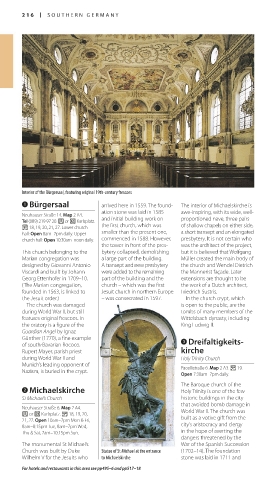
Interior of the Bürgersaal, featuring original 19th-century frescoes was originally occupied Baroque style in properties that he intended
by a Marian chapel, 1620–21. The church to convert into a family home.
1 Bürgersaal arrived here in 1559. The found- The interior of Michaelskirche is built in the 13th was deconsecrated He subsequently acquired a
ation stone was laid in 1585 awe-inspiring, with its wide, well- century. Some two in 1803. plot adjacent to these properties,
Neuhauser Straße 14. Map 2 A4.
Tel (089) 219 97 20. or Karlsplatz. and initial building work on proportioned nave, three pairs hundred years later, Since 1966, the where he wished to build a
v 18, 19, 20, 21, 27. Lower church the first church, which was of shallow chapels on either side, Prince Sigismund building’s ornate church devoted to the newly
hall: Open 8am–7pm daily. Upper smaller than the present one, a short transept and an elongated ordered a new, Rococo interior canonized St Nepomuk, a
church hall: Open 10:30am–noon daily. commenced in 1588. How ever, presbytery. It is not certain who much bigger church has housed a very Bohemian monk who had
the tower in front of the pres- was the architect of the project, to be built on the site. interesting museum, drowned in the Vltava river
This church belonging to the bytery collapsed, demolish ing but it is believed that Wolfgang Its architects were Jörg with a collection of in Prague. Above the entrance
Marian congregation was a large part of the building. Müller created the main body of von Halspach and Carving on main weapons dating from to the church is a statue of
designed by Giovanni Antonio A transept and new presbytery the church and Wendel Dietrich Lukas Rottaler. The Frauenkirche portal the Renaissance, the saint.
Viscardi and built by Johann were added to the remaining the Mannerist façade. Later Frauenkirche was Baroque and Rococo At the same time, Cosmas
Georg Ettenhofer in 1709–10. part of the building and the extensions are thought to be completed in 1488, though the periods, as well as hunting Damian, the brother of Egid
(The Marian congregation, church – which was the first the work of a Dutch architect, distinctive copper onion-domes trophies and related paintings, Quirin Asam, bought a plot on
founded in 1563, is linked to Jesuit church in northern Europe Friedrich Sustris. were not added to its towers prints and dioramas. Artists which he built the presbytery.
the Jesuit order.) – was consecrated in 1597. In the church crypt, which until 1525. The church is one of The church building
The church was damaged is open to the public, are the southern Germany’s biggest adjoins the residential
during World War II, but still tombs of many members of the Gothic structures, which can house of Egid Quirin.
features original frescoes. In Wittelsbach dynasty, including accommodate a congregation The two buildings
the oratory is a figure of the King Ludwig II. of about 2,000. were joined by a
Guardian Angel by Ignaz A triple-nave hall with no corridor and from
Günther (1770), a fine example 3 Dreifaltigkeits transept features rows of side one of his bedroom
of south-Bavarian Rococo. chapels, a gallery surrounding windows the
Rupert Mayer, parish priest kirche the choir and a monumental artist could see
during World War II and Holy Trinity Church western tower. The whole huge the main altar.
Munich’s leading opponent of Pacellistraße 6. Map 2 A3. v 19. structure measures over 100 m In this small but
Nazism, is buried in the crypt. (330 ft) in length and almost unique church,
Open 7:30am–7pm daily.
40 m (130 ft) wide. the Asam brothers
The Baroque church of the The church treasures that achieved a rare and
2 Michaelskirche Holy Trinity is one of the few escaped destruction during striking unity of
St Michael’s Church historic buildings in the city World War II include a Marian style. In the dimly
that avoided bomb damage in painting, dating from around lit interior, with its
Neuhauser Straße 6. Map 2 A4.
or Karlsplatz. v 18, 19, 20, World War II. The church was 1500, by Jan Polak; the altar of St dynamically shaped
21, 27. Open 10am–7pm Mon & Fri, built as a votive gift from the Andrew in St Sebastian’s chapel, single nave, no
8am–8:15pm Tue, 8am–7pm Wed, city’s aristocracy and clergy with statues by Meister von surface is left
Thu & Sat, 7am–10:15pm Sun. in the hope of averting the Rabenden and paintings by Jan unembellished. The
dangers threatened by the Polak, dating from 1510; and the eye is drawn to the
The monumental St Michael’s War of the Spanish Succession monumental tomb of Emperor altar, which features
Church was built by Duke Statue of St Michael at the entrance (1702–14). The foundation Ludwig IV of Bavaria, the work of a sculpted group
Wilhelm V for the Jesuits who to Michaelskirche stone was laid in 1711 and Hans Krumpper (1619–22). Pulpit in the Rococo-style Asamkirche of the Holy Trinity.
For hotels and restaurants in this area see pp495–6 and pp517–18
216-217_EW_Germany.indd 216 09/10/17 12:59 pm 216-217_EW_Germany.indd 217 09/10/17 12:59 pm

