


Page 324 - (DK Eyewitness) Travel Guide - Germany
P. 324
322 SOUTHERN GERM AN Y BADEN-W Ü R T TEMBERG 323
f Ulm Hans Multscher (1443),
the famous stalls with
Road map C6. * 115,000. £
n Münsterplatz 50 (0731-161 28 30. figures of philosophers,
_ Fischerstechen (every 4th year in poets, prophets and
Jul, next is 2021), Schwörmontag (3rd apostles carved by
Mon in Jul), Stadtfest (Jun). Jörg Syrlin the Elder,
∑ tourismus.ulm.de 15th-century stained-
glass windows, and the
Lying on the river Danube, Ulm font, by Jörg Syrlin
dates back to 854. It became a the Younger.
town in 1165 then, in 1274, a The town has many
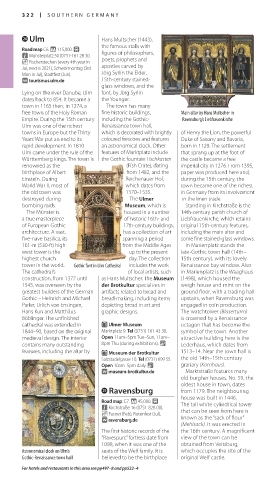
free town of the Holy Roman fine historic buildings, Main altar by Hans Multscher in
Empire. During the 15th century including the Gothic- Ravensburg’s Liebfrauenkirche
Ulm was one of the richest Renaissance town hall,
towns in Europe but the Thirty which is decorated with brightly of Henry the Lion, the powerful
Years’ War put an end to its coloured frescoes and features Duke of Saxony and Bavaria,
rapid development. In 1810 an astronomical clock. Other born in 1129. The settlement Former Cistercian abbey complex in Salem, now a secular building
Ulm came under the rule of the features of Marktplatz include that sprang up at the foot of
Württemberg kings. The town is the Gothic fountain Fisch kasten the castle became a free h Weingarten of relicts that have been found relaxed to the extent that the
renowned as the (Fish Crate), dating imperial city in 1276. From 1395, Road map: C7. * 24,500. £ in graves dating from the abbey now has an interesting
birthplace of Albert from 1482, and the paper was produced here and, n Münsterplatz 1 (0751-40 52 32). Merovingian period. tabernacle (1500), stalls (1594)
Einstein. During Reichenauer Hof, during the 15th century, the _ Blutritt (day after Ascension). and early-Renaissance altars
World War II, most of which dates from town became one of the richest E Alamannenmuseum (dating from the 18th century).
the old town was 1370–1535. in Germany from its involvement The House of Welf founded Karlstraße 28. Tel (0751) 40 52 55. The new abbey buildings
destroyed during The Ulmer in the linen trade. a Benedictine abbey in Open 2–5pm Tue–Sun. & were built between 1700 and
bombing raids. Museum, which is Standing in Kirchstraße is the Weingarten in 1056. During the 1710 and constitute Schloß
The Münster is housed in a number 14th-century parish church of Romanesque period, around Salem. The buildings include
a true masterpiece of historic 16th- and Liebfrauenkirche, which retains 1190, the monks of the abbey j Salem some richly decorated abbot’s
of European Gothic 17th-century buildings, original 15th-century features, produced a chronicle of the Road map: C7. * 8,500. apartments and the extremely
architecture. A vast, has a collection of art including the main altar and House of Welfs, known as n Schloß Salem (07553-91 77 15). impressive Emperor’s room
five-nave basilica, its spanning a period some fine stained-glass windows. the Welfenchronik. (Kaisersaal), which was built
161-m (530-ft) high from the Middle Ages In Marienplatz stands the Ambitious plans, drawn up in The first Cistercian monks between 1708 and 1710.
west tower is the up to the present late-Gothic town hall (14th– the 18th century at the initiative arrived in Salmansweiler (now Since its secularization in
highest church day. The collection 15th century), with its lovely of Abbot Sebastian Hyller, known as Salem) in 1134. 1802, the abbey has been the
tower in the world. Gothic font in Ulm Cathedral includes the work Renaissance bay window. Also provided for an extension of Between 1299 and 1414 they private property of the Baden
The cathedral’s of local artists, such in Marienplatz is the Waaghaus the abbey and the construction built a church according to margraves who keep some of
construction, from 1377 until as Hans Multscher. The Museum (1498), which housed the of another vast complex of the rules of their order, which their art collection here. The
1545, was overseen by the der Brotkultur specializes in weigh-house and mint on the buildings. Two side courtyards espoused poverty and banned west wing houses a private
greatest builders of the German artifacts related to bread and ground floor, with a trading hall and four external courtyards, any decoration of the buildings. boarding school founded by
Gothic – Heinrich and Michael bread-making, including items upstairs, when Ravensburg was encircled with curved galleries The abbey is a triple-nave Kurt Hahn, who also founded
Parler, Urlich von Ensingen, depicting bread in art and engaged in coin production. with smaller pavilions, were basilica with transept and Gordonstoun in Scotland.
Hans Kun and Matthäus graphic designs. The watchtower (Blaserturm) planned to be grouped around straight-end choir. Its austere
Böblinger. The unfinished is crowned by a Renaissance the church. These were designed façade is relieved by blind + Schloß Salem
cathedral was extended in E Ulmer Museum octagon that has become the by Casper Moosbrugger, Franz windows, some of which have Tel (07553) 916 53. Open Apr–Oct:
1844–90, based on the original Marktplatz 9. Tel (0731) 161 43 30. symbol of the town. Another Beer, Donato Giuseppe Frisoni attractive traceries. In later years 9:30am–6pm Mon–Sat, 10:30am–6pm
medieval design. The interior Open 11am–5pm Tue–Sun, 11am– attractive building here is the and others, and built in 1715–24. the restraints of poverty were Sun. &
contains many outstanding 8pm Thu (during exhibitions). & Lederhaus, which dates from The church is reminiscent of
features, including the altar by E Museum der Brotkultur 1513–14. Near the town hall is the Basilica of St Peter’s in
Salzstadelgasse 10. Tel (0731) 699 55. the old 14th–15th century Rome. Although it is half the
Open 10am–5pm daily. & granary (Kornhaus). size of the latter, it is never-
∑ museum-brotkultur.de Marktstraße features many theless an immense structure.
old burgher houses. No. 59, the Inside are some magnificent
oldest house in town, dates ceiling frescoes by Cosmas
g Ravensburg from 1179. The neighbouring Damian Asam, while the
house was built in 1446. carved and inlaid choir stalls
Road map: C7. * 45,000. £ The tall white cylindrical tower
n Kirchstraße 16 (0751-828 00). are the work of Joseph Anton
_ Fasnet (Feb), Rutenfest (Jul). that can be seen from here is Feuchtmayer. Also of note is the
∑ ravensburg.de known as the “sack of flour” organ by Josef Gabler. In an
(Mehlsack). It was erected in ingenious design, the organ
The first historic records of the the 16th century. A magnificent pipes are concealed within a
“Ravespurc” fortress date from view of the town can be series of towers to avoid
1088, when it was one of the obtained from Veitsburg, obscuring the windows of the
Astronomical clock on Ulm’s seats of the Welf family. It is which occupies the site of the façade. The Alamannenmuseum
Gothic-Renaissance town hall believed to be the birthplace original Welf castle. has a fascinating exhibition Ceiling fresco in Weingarten’s abbey
For hotels and restaurants in this area see pp497–8 and pp522–4
322-323_EW_Germany.indd 322 09/10/17 1:00 pm 322-323_EW_Germany.indd 323 09/10/17 1:00 pm
Eyewitness Travel LAYERS PRINTED:
Catalogue template “UK” LAYER
(Source v2.2)
Date 15th January 2013
Size 125mm x 217mm

