


Page 376 - (DK Eyewitness) Travel Guide - Germany
P. 376
374 WESTERN GERM AN Y HESSE 375
7 Gießen Along with the old stable block inspired Goethe to write his bridge. In Frankfurtstraße stands a Baroque palace built in 1678–
in Dammstraße, it is the only tragic novel, The Sorrows of Young the Heiliggrabkapelle (Chapel 86. It features a magnificent
Road map C4. * 72,000. £
n Berliner Platz 2 (0641-306 18 90). half-timbered building that Werther (1774). Jerusalem had of the Holy Sepulchre), dating Festsaal (ballroom) and
∑ giessen-entdecken.de has survived to this day. suffered unrequited love, just like from 1505. Spiegelkabinett (hall of mirrors).
Goethe. The novel, which was The only part of the former
Gießen was granted town status published two years later, made 0 Limburg complex remaining today is
in 1248, and in 1607 it acquired 8 Wetzlar Goethe famous around Europe, the 14th-century Weißer Turm
its university. In Brandplatz stands Road map C5. * 52,000. £ but it also unwittingly led many Road map B5. * 31,000. £ (white tower). Following the
the partially reconstructed Altes n Domplatz 8 (06441-997 755). young men to commit suicide. n Bahnhofsplatz 2 (06431-61 66). annexation of Hesse-Homburg
Schloß (old palace), dating from ∑ wetzlar.de by Prussia in 1866, the palace
the 14th–15th centuries. Now Limburg’s history dates back became the favourite summer
the home of the Oberhessisches Occupying a picturesque spot to the 8th century. In 1821, residence of the royal then
Museum, it holds a large on the banks of the Lahn river, the town became the see (from 1871) imperial family.
collection of art dating from Wetzlar is overlooked by the of a newly created diocese. Along with Baden-Baden and
the Gothic period to today. ruins of the 12th-century The Dom (collegiate cathedral Wiesbaden, Homburg was one
The Botanischer Garten is Kalsmunt fort ress. It was built church of St George) towers of Germany’s most fashionable
one of Germany’s oldest for the Emperor Friedrich I high above the Lahn river. Romanesque–Gothic wall paintings in the spas, and today the town reflects
botanical gardens, established Barbar ossa (1122–90). Only This monumental building, Dom in Limburg its former splendour. The Kurpark,
in 1609 for the purposes of parts of the tower remain intact. whose style combines late- a landscaped park established
scientific research. To the north of The Dom (Collegiate Church of Romanesque and early French- the 13th century. Near the in 1854–67, was designed by
it stands the Neues Schloß (new St Mary) was begun in 897 but Gothic, was erected in 1190– 14th-century Alte Lahnbrücke Peter Joseph Lenné.
palace), built in 1533–9 for by the late 15th century had only 1250. Its well-proportioned (old Lahn bridge), with its The Spielbank (1838), in
Landgrave Philipp the been partly completed. The interior contains a rich variety of defensive towers, stands a Brunnenallee claims to be the
Magnanimous. It miracul ously splendid western double portal historic artifacts, including some mansion belonging to the oldest casino in the world. Built
escaped damage when the town has remained unusable for the 13th-century wall paintings in Cistercians of Eberbach. The in 1887–90, the Kaiser-Wilhelm-
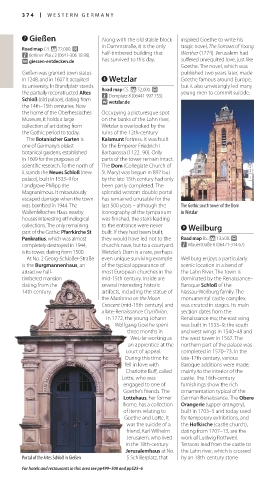
was bombed in 1944. The last 500 years – although the The Gothic south tower of the Dom the presbytery and the transept, post-Franciscan Sebastiankirche Bad is still used as the main
Wallenfelssches Haus nearby iconography of the tympanum in Wetzlar a font dating from the same (church of St Sebastian) dates bath complex for therapeutic
houses interesting ethnological was finished, the stairs leading period and the tombstone of from the 14th and 18th centuries. treatments. An Orthodox
collections. The only remaining to the entrance were never 9 Weilburg Konrad Kurzbold, who founded chapel, designed by Leonti
part of the Gothic Pfarrkirche St built. If they had been built, the first church on this site. Nikolayevich Benois for the
Pankratius, which was almost they would have led not to the Road map B5. * 13,500. £ To the south of the Dom q Bad Homburg Russian Orthodox nobility,
completely destroyed in 1944, church’s nave, but to a courtyard. n Mauerstraße 6 (06471-314 67). stands the Burg (castle), an Road map C5. * 52,000. £ was finished in 1899.
is its tower, dating from 1500. Wetzlar’s Dom is a rare, perhaps irregular structure built in the n Kurhaus, Louisenstraße 58 (06172-
At No. 2 Georg-Schloßer-Straße even unique surviving example Weilburg enjoys a parti cularly 13th–16th centuries. It houses 178 37 10). _ Fugato Organ Festival Environs
is the Burgmannen haus, an of the typical appearance of scenic location in a bend of the interesting Diözesan- (Sep every two years – next in, 2018), Saalburg, 7 km (4 miles) to
attractive half- most European churches in the the Lahn River. The town is museum (Diocese museum). Laternenfest (Sep yearly). the northwest, has a Roman
timbered mansion mid-15th century. Inside are dominated by the Renaissance– Limburg has many original fortress, which was completely
dating from the several interesting historic Baroque Schloß of the examples of beautiful half- Bad Homburg grew up around reconstructed in 1898–1901.
14th century. artifacts, including the statue of Nassau-Weilburg family. The timbered buildings. The houses a fortress whose earliest records The fortress formed part of the
the Madonna on the Moon monumental castle complex at No. 1 Römerstraße, No. 6 date back to 1180. Friedrich II limes, the fortified border that
Crescent (mid-15th century) and was created in stages. Its main Kolpingstraße, No. 4 Kleine von Hessen-Homburg initiated separated the Roman Empire
a late-Renaissance Crucifixion. section dates from the Rütsche and No. 11 Kornmarkt the con version of the medieval from its Germanic neighbours
In 1772, the young Johann Renaissance era; the east wing date from the last decade of castle into the Schloß, in the 1st to 3rd century AD.
Wolfgang Goethe spent was built in 1533–9; the south
three months in and west wings in 1540–48 and
Wetzlar working as the west tower in 1567. The
an apprentice at the northern part of the palace was
court of appeal. completed in 1570–73. In the
During this time he late-17th century, various
fell in love with Baroque additions were made,
Charlotte Buff, called mainly to the interior of the
Lotte, who was castle. The 16th-century
engaged to one of furnishings show the rich
Goethe’s friends. The ornamentation typical of the
Lottehaus, her former German Renaissance. The Obere
home, has a collection Orangerie (upper orangery),
of items relating to built in 1703–5 and today used
Goethe and Lotte. It for temporary exhibitions, and
was the suicide of a the Hofkirche (castle church),
friend, Karl Wilhelm dating from 1707–13, are the
Jerusalem, who lived work of Ludwig Rothweil.
in the 18th-century Terraces lead from the castle to
Jerusalemhaus at No. the Lahn river, which is crossed
Portal of the Altes Schloß in Gießen 5 Schillerplatz, that by an 18th-century stone The grand edifice of the Kaiser-Wilhelm-Bad in the Kurpark, Bad Homburg
For hotels and restaurants in this area see pp499–500 and pp525–6
374-375_EW_Germany.indd 374 09/10/17 2:30 pm 374-375_EW_Germany.indd 375 09/10/17 2:30 pm
Eyewitness Travel LAYERS PRINTED:
Catalogue template “UK” LAYER
(Source v2.2)
Date 15th January 2013
Size 125mm x 217mm

