


Page 459 - (DK Eyewitness) Travel Guide - Germany
P. 459
L OWER SA X ON Y , HA MBURG AND BREMEN 457
h The Weser Renaissance Trail
The Weser Renaissance is an architectural and
decorative style of northern Germany, dating from
the mid-16th to the mid-17th century. Its tall roofs and
gables were inspired by Dutch architecture, although
it has many original features: the Zwerchhäuser (bay
windows, one or more storeys high), the Utlucht
(prot ruding sections of the façade),
lavish decorations and multi-
wing castles, some with
spiral staircases in WESERGEBIRGE
their towers.
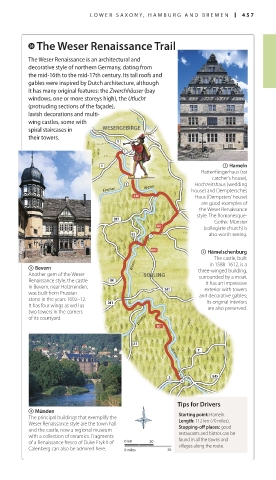
1 Hameln
Rattenfängerhaus (rat
catcher’s house),
Hochzeitshaus (wedding
Emmer Weser house) and Demptersches
Haus (Dempsters’ house)
are good examples of
the Weser Renaissance
style. The Romanesque-
Gothic Münster
(collegiate church) is
also worth seeing.
2 Hämelschenburg
The castle, built
Weser in 1588–1612, is a
3 Bevern three-winged building,
Another gem of the Weser SOLLING surrounded by a moat.
Renaissance style, the castle It has an impressive
in Bevern, near Holzminden, ex terior with towers
was built from Prussian and decorative gables;
stone in the years 1602–12. its original interiors
It has four wings as well as are also preserved.
two towers in the corners
Diemel Weser
of its courtyard.
Tips for Drivers
4 Münden Starting point: Hameln.
The principal buildings that exemplify the Length: 112 km (70 miles).
Weser Renaissance style are the town hall Stopping-off places: good
and the castle, now a regional museum restaurants and bistros can be
with a collection of ceramics. Fragments found in all the towns and
of a Renaissance fresco of Duke Eryk II of 0 km 20 villages along the route.
Calenberg can also be admired here. 0 miles 20
456-457_EW_Germany.indd 457 09/10/17 12:50 pm

