


Page 467 - (DK Eyewitness) Travel Guide - Germany
P. 467
SCHLESWIG-HOLSTEIN 465
created Geistkämpfer, the Emil Nolde (1867–1956)
sculpture outside the church,
which symbolizes the triumph Born Emil Hansen, this great artist later
of mind over matter. Pieces of adopted the name of the town in which
the sculpture, which had been he was born. After studying art in
cut up by the National Socialists, Copenhagen, Munich and Paris, Nolde
were found and reassembled devoted himself to painting, and was
after the war. also successful in the graphic arts. From
1906–7 he belonged to the Expressionist
The most interesting of group Die Brücke. He is known
Kiel’s many museums is the particularly for his use of vivid colours
Schleswig-Holsteinisches and highly expressive features, embuing
Freilichtmuseum, an open- his subjects with great emotion.
air museum in Molfsee, 6 km Rejected and forbidden to paint by the
(4 miles) from the centre of National Socialists as an exponent of
Kiel, where German rural “degen erate art”, Nolde settled and continued to paint in Seebüll,
architecture from the 16th– where a house was built for him to his own designs.
19th centuries is on show.
Pottery, basket-making and
baking are demonstrated, and Plön on the Großer Plöner See
the products are sold here. (large Plön lake). Nearby is
Preetz, an old shoemakers’
E Schleswig-Holsteinisches town, which has a towerless
Freilichtmuseum Gothic church that belonged
Hamburger Landstraße 97. Tel (0431) to a former Benedictine
65 96 60. Open Apr–Oct: 9am–6pm monastery. Older still is the
daily; Nov–Mar: 11am–4pm Sun. & Romanesque church in Bosau,
a small town in a picturesque
8 Holsteinische location on the Großer Plöner
Schweiz (Holstein’s See. It was the first bishopric in
this area, and home to Vizelin –
Switzerland) the apostle of the Slavs. The Dom in Ratzeburg
It is also worth visiting Eutin,
Road map D1. £ n Bahnhofstraße 9 Ratzeburg
3, Malente (0800 20 20 080). _ Jazz- a small town full of picturesque
Festival in Plön (May); open-air opera buildings, which is sometimes Road map D2. * 12,500. £
during Sommerspiele in Eutin. referred to as the “Weimar of the n Unter den Linden 1 (04541-80 00
north”. The original Schloß, a 886). _ Drachenbootfest (Jun).
The moraine hills, which reach a brick structure with four wings,
height of 164 m (538 ft), and was built in the Middle Ages as Ratzeburg, situated on an island
140 lakes are the reasons why the residence of the Lübeck in the Großer Ratzebur ger See,
this area is known as Holstein’s bishops, but it was substant ially is linked with the mainland by
Switzerland. The best means of altered in 1716–27. Worth three causeways. The town was
transport here is the bicycle, seeing inside are the palace named after Ratibor, the duke of
allowing visitors to appreciate chapel, the Blauer Salon (blue the Elbe River area. Henry the
the beauty of nature and the salon) with Rococo stucco work, Lion established a missionary
wealth of the fauna – as well as paintings by Johann bishopric here in 1154, and
ornithologists have counted Heinrich Wilhelm Tischbein, later it became the residence
200 species of birds. which were inspired by the Iliad of the Lauenburg dukes.
The main centre of and the Odyssey, epic poems The Dom (cathedral) is one
this holiday area is written by Homer. of the earliest examples of
brick architecture, a style
that was imported from
Lombardy. The southern
vestibule of the Romanesque
basilica is particularly
impressive – with herringbone-
pattern brickwork and lines
of black tiles as interior
decoration. The Romanesque
stalls, a 13th-century crucifix
in a rainbow arch, the ducal
gallery above the nave and
the Baroque altar in the
southern transept are some
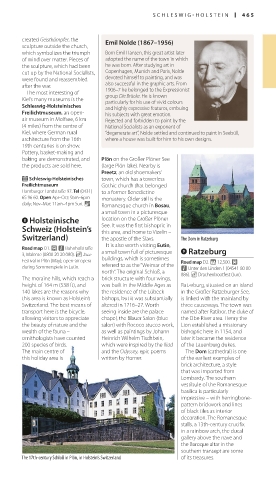
The 17th-century Schloß in Plön, in Holstein’s Switzerland of its treasures.
464-465_EW_Germany.indd 465 09/10/17 2:34 pm

