


Page 17 - Reptiles & Dinosaurs (Britannica Illustrated Science Library)
P. 17
12 DINOSAURS                                                                          REPTILES AND DINOSAURS  13


 The “Age of Reptiles”  HERRERASAURUS         DIFFERENT SIZES

        Herrerasaurus ischigualastensis
 he first period of the Mesozoic Era gave rise to the “Age of Reptiles.” On land, the synapsids, which  Size  13 feet (4 m)
 later developed into mammals, began to decline, and the archosaurs, or “dominant reptiles,” lived  Diet  Carnivorous
        Habitat
                         Conifer Forests
 T in various habitats. The earliest crocodiles began to develop, along with turtles and frogs, among  Epoch  Late Triassic
 others. The pterosaurs ruled the air and the ichthyosaurs the water. The dinosaurs—another order of  Range  South America  Mussaurus  Eoraptor  Coelophysis  Herrerasaurus
 archosaurs—appeared in the Middle Triassic, approximately 250 million years ago. Toward the end of
 the Triassic Period, many other reptiles declined dramatically, and the dinosaurs began their reign.
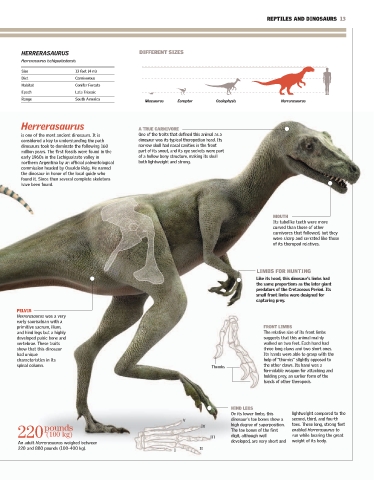
        Herrerasaurus                         A TRUE CARNIVORE

        is one of the most ancient dinosaurs. It is  One of the traits that defined this animal as a
        considered a key to understanding the path  dinosaur was its typical theropodian head. Its
 The First Dinosaurs  Eoraptor  dinosaurs took to dominate the following 160  narrow skull had nasal cavities in the front
                                              part of its snout, and its eye sockets were part
        million years. The first fossils were found in the
 The most primitive dinosaurs were  Eoraptor fossils were  early 1960s in the Ischigualasto valley in  of a hollow bony structure, making its skull
 very small in comparison to their  discovered in 1991 in  northern Argentina by an official paleontological  both lightweight and strong.
 relatives of later epochs. Most of them have  northwestern Argentina.  commission headed by Osvaldo Reig. He named
 been found in South America. They were  This small carnivore lived 228  the dinosaur in honor of the local guide who
 carnivores. Some were scavengers, and  million years ago and measured  found it. Since then several complete skeletons
 others were highly agile hunters. They shared  up to 40 inches (1 m) long. It had  have been found.
 very primitive morphological structures with  sharp teeth and agile hind legs for
 other reptiles of their group, the archosaurs.  running and chasing its prey. It may
 Mixed with these primitive structures,  also have eaten carrion.
 however, were advanced bone forms similar
 to those of the predators that would
 dominate the Cretaceous Period. These                                                   MOUTH
 predators were known as the theropods.                                                  Its tubelike teeth were more
 Throughout the Triassic Period, the early                                               curved than those of other
 dinosaurs were an uncommon subgroup of  EORAPTOR                                        carnivores that followed, but they
 reptiles. Toward the end of the Triassic  Tiny predator whose name                      were sharp and serrated like those
 Period, the first large herbivores appeared.  means “thief of dawn”                     of its theropod relatives.


                                                                                   LIMBS FOR HUNTING
 HOLLOW SHAPE                                                                      Like its head, this dinosaur's limbs had
 is what Coelophysis means.
                                                                                   the same proportions as the later giant
                                                                                   predators of the Cretaceous Period. Its
                                                                                   small front limbs were designed for
 TAIL                                                                              capturing prey.
 Most predators used their
 tails to keep their balance  SPINAL COLUMN  PELVIS
 while chasing their prey.  The central vertebrae are high and  Herrerasaurus was a very
 short, and the neural arches have  early saurischian with a
 square-shaped projections that are  primitive sacrum, ilium,                         FRONT LIMBS
 thicker toward the back. There are  and hind legs but a highly                       The relative size of its front limbs
 only two sacral vertebrae.  developed pubic bone and                                 suggests that this animal mainly
      vertebrae. These traits                                                         walked on two feet. Each hand had
 Mussaurus  show that this dinosaur                                                   three long claws and two short ones.
                                                                                      Its hands were able to grasp with the
      had unique
 The only known fossils of this species were  characteristics in its                  help of “thumbs” slightly opposed to
 found alongside eggshells. They were no more  spinal column.        Thumbs           the other claws. Its hand was a
 than 8 inches (20 cm) long. Their adult size is                                      formidable weapon for attacking and
 unknown, but it is estimated to have been as                                         holding prey, an earlier form of the
 much as 6.5 to 8 feet (2-2.5 m). They are                                            hands of other theropods.
 known to have been herbivores.
 Coelophysis
 This skilled carnivore could grow up to 9.2                               HIND LEGS
 feet (2.8 m) long. Two types of fossils have                              On its lower limbs, this  lightweight compared to the
 been found. They are believed to be males                  V              dinosaur's toe bones show a  second, third, and fourth
 and females, respectively. Fossils of  pounds                    IV       high degree of superposition.  toes. These long, strong feet
 this biped hunter have been found                                         The toe bones of the first  enabled Herrerasaurus to
 in the United States in several  220 (100 kg)                       III   digit, although well  run while bearing the great
 southwestern states.  MUSSAURUS  An adult Herrerasaurus weighed between   developed, are very short and  weight of its body.
 means “rat reptile.”   220 and 880 pounds (100-400 kg).  I      II

