


Page 62 - All About History - Issue 16-14
P. 62
Secrets of the Mayans


   © Sol 90 Images


           Pok-Ta-Pok An ancient game of life and death

           A common feature of many Mayan towns were   was played, the stone slabs transformed into a   The players could only use their hips, shoulders,
           the great masonry structures used to host grand   battleground, a sacred place, a portal between this   head and knees as the use of feet or hands was
           feasts, conduct rituals and display wrestling   world and the one beyond. Two opposing teams   forbidden. Players would dash around the court
           matches. However, their primary purpose and   would face each other with the aim of keeping   with lighting-quick speed in an attempt to lead
           most popular attraction was the deadly Mayan   the ball in play and, for an instant win, directing   their team to victory, as a single wrong move
           ball game of Pok-Ta-Pok. As the ancient game   the ball through a high mounted vertical hoop.   could mean the difference between life and death.


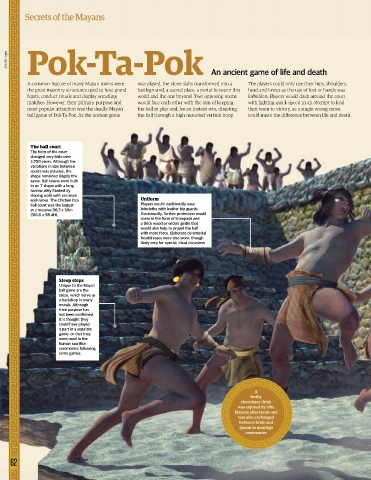
            The ball court
            The form of the court
            changed very little over
            2,700 years. Although the
            variations in size between
            courts was massive, the
            shape remained largely the
            same. Ball courts were built
            in an ‘I’ shape with a long
            narrow alley flanked by
            sloping walls with enclosed
            end-zones. The Chichen Itza           Uniform
            ball court was the largest            Players would traditionally wear
            at a massive 96.5 x 30m               loincloths with leather hip guards.
            (316.6 x 98.4ft).                     Occasionally, further protection would
                                                  come in the form of kneepads and
                                                  a thick wood or wicker girdle that
                                                  would also help to propel the ball
                                                  with more force. Elaborate ceremonial
                                                  headdresses were also worn, though
                                                  likely only for special, ritual occasions.


                      Steep steps
                      Unique to the Mayan
                      ball game are the
                      steps, which serve as
                      a backdrop in many
                      murals. Although
                      their purpose has
                      not been confirmed,
                      it is thought they
                      could have played
                      a part in a separate
                      game, or that they
                      were used in the
                      human sacrifice
                      ceremonies following
                      some games.


                                                                                           A
                                                                                         frothy
                                                                                      chocolatey drink
                                                                                     was enjoyed by elite
                                                                                   Mayans after meals and
                                                                                     was also exchanged
                                                                                     between bride and
                                                                                     groom in marriage
                                                                                       ceremonies


     62

