


Page 22 - Classic Rock - The Complete Story of Def Leppard 2019
P. 22
playing exactly what we were playing, and
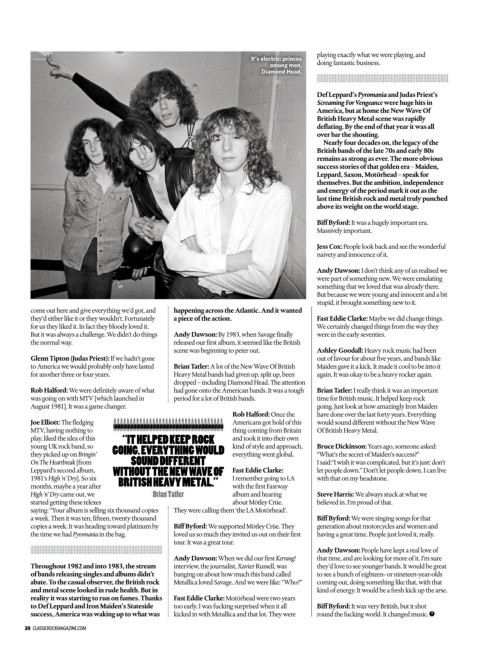
                                                                                           It’s electric: princes
                                                                                                  among men,      doing fantastic business.
                                                                                               Diamond Head.


                                                                                                                  Def Leppard’s Pyromania and Judas Priest’s
                                                                                                                  Screaming For Vengeance were huge hits in
                                                                                                                  America, but at home the New Wave Of
                                                                                                                  British Heavy Metal scene was rapidly
                                                                                                                  deflating. By the end of that year it was all
                                                                                                                  over bar the shouting.
                                                                                                                     Nearly four decades on, the legacy of the
                                                                                                                  British bands of the late 70s and early 80s
                                                                                                                  remains as strong as ever. The more obvious
                                                                                                                  success stories of that golden era – Maiden,
                                                                                                                  Leppard, Saxon, Motörhead – speak for
                                                                                                                  themselves. But the ambition, independence
                                                                                                                  and energy of the period mark it out as the
                                                                                                                  last time British rock and metal truly punched
                                                                                                                  above its weight on the world stage.


                                                                                                                  Biff Byford: It was a hugely important era.
                                                                                                                  Massively important.

                                                                                                                  Jess Cox: People look back and see the wonderful
                                                                                                                  naivety and innocence of it.


                                                                                                                  Andy Dawson: I don’t think any of us realised we
                                                                                                                  were part of something new. We were emulating
                                                                                                                  something that we loved that was already there.
                                                                                                                  But because we were young and innocent and a bit
                                                                                                                  stupid, it brought something new to it.
            come out here and give everything we’d got, and    happening across the Atlantic. And it wanted
            they’d either like it or they wouldn’t. Fortunately   a piece of the action.                          Fast Eddie Clarke: Maybe we did change things.
            for us they liked it. In fact they bloody loved it.                                                   We certainly changed things from the way they
            But it was always a challenge. We didn’t do things   Andy Dawson: By 1983, when Savage finally        were in the early seventies.
            the normal way.                                    released our first album, it seemed like the British
                                                               scene was beginning to peter out.                  Ashley Goodall: Heavy rock music had been
            Glenn Tipton (Judas Priest): If we hadn’t gone                                                        out of favour for about five years, and bands like
            to America we would probably only have lasted      Brian Tatler: A lot of the New Wave Of British     Maiden gave it a kick. It made it cool to be into it
            for another three or four years.                   Heavy Metal bands had given up, split up, been     again. It was okay to be a heavy rocker again.
                                                               dropped – including Diamond Head. The attention
            Rob Halford: We were definitely aware of what      had gone onto the American bands. It was a tough   Brian Tatler: I really think it was an important
            was going on with MTV [which launched in           period for a lot of British bands.                 time for British music. It helped keep rock
            August 1981]. It was a game changer.                                                                  going. Just look at how amazingly Iron Maiden
                                                                                    Rob Halford: Once the         have done over the last forty years. Everything
            Joe Elliott: The fledging                                               Americans got hold of this    would sound different without the New Wave
            MTV, having nothing to                                                  thing coming from Britain     Of British Heavy Metal.
            play, liked the idea of this     “IT HELPED KEEP ROCK                   and took it into their own
            young UK rock band, so       GOING. EVERYTHING WOULD                    kind of style and approach,   Bruce Dickinson: Years ago, someone asked:
            they picked up on Bringin’                                              everything went global.       “What’s the secret of Maiden’s success?”
            On The Heartbreak [from             SOUND DIFFERENT                                                   I said:“I wish it was complicated, but it’s just: don’t
            Leppard’s second album,      WITHOUT THE NEW WAVE OF                    Fast Eddie Clarke:            let people down.” Don’t let people down. I can live
            1981’s High ’n’ Dry]. So six   BRITISH HEAVY METAL.”                    I remember going to LA        with that on my headstone.
            months, maybe a year after                                              with the first Fastway
            High ’n’ Dry came out, we                   Brian Tatler                album and hearing             Steve Harris: We always stuck at what we
            started getting these telexes                                           about Mötley Crüe.            believed in. I’m proud of that.
            saying: “Your album is selling six thousand copies   They were calling them ‘the LA Motörhead’.
            a week. Then it was ten, fifteen, twenty thousand                                                     Biff Byford: We were singing songs for that
            copies a week. It was heading toward platinum by   Biff Byford: We supported Mötley Crüe. They        generation about motorcycles and women and
            the time we had Pyromania in the bag.              loved us so much they invited us out on their first   having a great time. People just loved it, really.
                                                               tour. It was a great tour.
                                                                                                                  Andy Dawson: People have kept a real love of
                                                               Andy Dawson: When we did our first Kerrang!        that time, and are looking for more of it. I’m sure
            Throughout 1982 and into 1983, the stream          interview, the journalist, Xavier Russell, was     they’d love to see younger bands. It would be great
            of bands releasing singles and albums didn’t       banging on about how much this band called         to see a bunch of eighteen- or nineteen-year-olds
            abate. To the casual observer, the British rock    Metallica loved Savage. And we were like: “Who?”   coming out, doing something like that, with that
            and metal scene looked in rude health. But in                                                         kind of energy. It would be a fresh kick up the arse.
            reality it was starting to run on fumes. Thanks    Fast Eddie Clarke: Motörhead were two years
            to Def Leppard and Iron Maiden’s Stateside         too early. I was fucking surprised when it all     Biff Byford: It was very British, but it shot
            success, America was waking up to what was         kicked in with Metallica and that lot. They were   round the fucking world. It changed music.

          20  CLASSICROCKMAGAZINE.COM

