


Page 302 - Ultimate Visual Dictionary (DK)
P. 302
GEOLOGY, GEOGRAPHY, AND METEOROLOGY

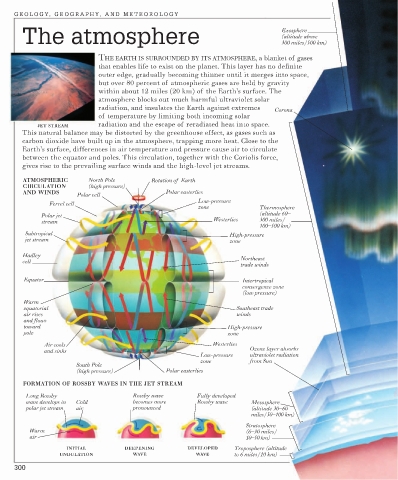
       The atmosphere                                                          Exosphere
                                                                               (altitude above
                                                                               300 miles/500 km)

                            THE EARTH IS SURROUNDED BY ITS ATMOSPHERE, a blanket of gases
                            that enables life to exist on the planet. This layer has no definite
                            outer edge, gradually becoming thinner until it merges into space,
                            but over 80 percent of atmospheric gases are held by gravity
                            within about 12 miles (20 km) of the Earth’s surface. The
                            atmosphere blocks out much harmful ultraviolet solar
                            radiation, and insulates the Earth against extremes
                                                                             Corona
                            of temperature by limiting both incoming solar
           JET STREAM       radiation and the escape of reradiated heat into space.
       This natural balance may be distorted by the greenhouse effect, as gases such as
       carbon dioxide have built up in the atmosphere, trapping more heat. Close to the
       Earth’s surface, differences in air temperature and pressure cause air to circulate
       between the equator and poles. This circulation, together with the Coriolis force,
       gives rise to the prevailing surface winds and the high-level jet streams.

       ATMOSPHERIC        North Pole       Rotation of  Earth
       CIRCULATION        (high pressure)
       AND WINDS                               Polar easterlies
                      Polar cell
                                                        Low-pressure
               Ferrel cell
                                                        zone             Thermosphere
            Polar jet                                                    (altitude 60–
                                                            Westerlies   300 miles/
            stream
                                                                         100–500 km)
        Subtropical                                              High-pressure
        jet stream                                               zone
       Hadley                                                       Northeast
       cell
                                                                    trade winds
        Equator                                                     Intertropical
                                                                    convergence zone
                                                                    (low pressure)
        Warm
        equatorial                                                 Southeast trade
        air rises                                                  winds
        and flows
        toward                                                  High-pressure
        pole                                                    zone

             Air cools                                      Westerlies
             and sinks                                                Ozone layer absorbs
                                                         Low-pressure   ultraviolet radiation
                                                         zone         from Sun
                      South Pole
                      (high pressure)          Polar easterlies
       FORMATION OF ROSSBY WAVES IN THE JET STREAM
        Long Rossby                   Rossby wave       Fully developed
        wave develops in   Cold       becomes more      Rossby wave    Mesosphere
        polar jet stream  air         pronounced                       (altitude 30–60
                                                                       miles/50–100 km)
                                                                     Stratosphere
         Warm                                                        (6–30 miles/
         air                                                         10–50 km)
                    INITIAL         DEEPENING        DEVELOPED    Troposphere (altitude
                  UNDULATION          WAVE             WAVE       to 6 miles/10 km)
     300

