


Page 398 - Ultimate Visual Dictionary (DK)
P. 398
SEA AND AIR

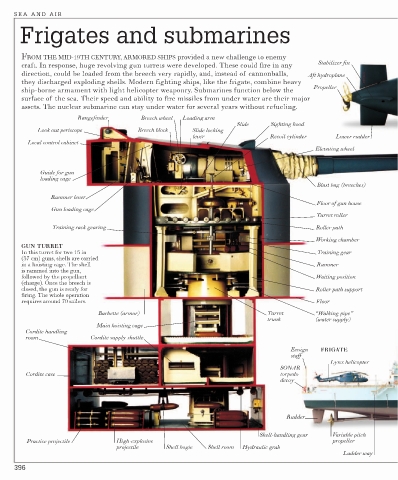
       Frigates and submarines


       FROM THE MID-19TH CENTURY, ARMORED SHIPS provided a new challenge to enemy
                                                                                         Stabilizer fin
       craft. In response, huge revolving gun turrets were developed. These could fire in any
       direction, could be loaded from the breech very rapidly, and, instead of cannonballs,   Aft hydroplane
       they discharged exploding shells. Modern fighting ships, like the frigate, combine heavy
                                                                                        Propeller
       ship-borne armament with light helicopter weaponry. Submarines function below the
       surface of the sea. Their speed and ability to fire missiles from under water are their major
       assets. The nuclear submarine can stay under water for several years without refueling.
                       Rangefinder      Breech wheel  Loading arm
                                                                   Slide    Sighting hood
           Look out periscope          Breech block    Slide locking
                                                       lever                Recoil cylinder   Lower rudder
         Local control cabinet
                                                                                         Elevating wheel


            Guide for gun
            loading cage
                                                                                         Blast bag (breeches)
               Rammer lever
                                                                                         Floor of gun house
               Gun loading cage
                                                                                         Turret roller
                Training rack gearing                                                    Roller path
                                                                                         Working chamber
       GUN TURRET
       In this turret for two 15 in                                                      Training gear
       (37 cm) guns, shells are carried
       in a hoisting cage. The shell                                                     Rammer
       is rammed into the gun,
       followed by the propellant                                                        Waiting position
       (charge). Once the breech is
       closed, the gun is ready for                                                      Roller path support
       firing. The whole operation
       requires around 70 sailors.                                                       Floor
                            Barbette (armor)                               Turret        “Walking pipe”
                                                                           trunk         (water supply)
                            Main hoisting cage
        Cordite handling
        room              Cordite supply shuttle
                                                                                  Ensign   FRIGATE
                                                                                  staff
                                                                                             Lynx helicopter
                                                                               SONAR
        Cordite case                                                           torpedo
                                                                               decoy


                                                                                 Rudder

                                                                         Shell-handling gear  Variable pitch
        Practice projectile      High-explosive                                              propeller
                                 projectile    Shell bogie  Shell room  Hydraulic grab
                                                                                                Ladder way

     396

