


Page 18 - The Complete Dog Breed Book Choose the Perfect Dog for You, New Edition (DK)
P. 18
18     INTRODUC TION T O DOG S


        Finding a breeder
        If you decide to buy a pedigree dog, you need to find
        a reputable breeder. A recommendation from your vet
        or a friend is ideal, and some kennel clubs provide lists
        of breeders; otherwise, the best way to choose a breeder
        is to visit several armed with a list of questions. (See box
        opposite for the most important ones to ask.)
          Good breeders will be happy to give you plenty of time
        to observe the litter. It is particularly important to see
        puppies with their littermates and their mother. Young
        puppies should never be kept in isolation, and if this is
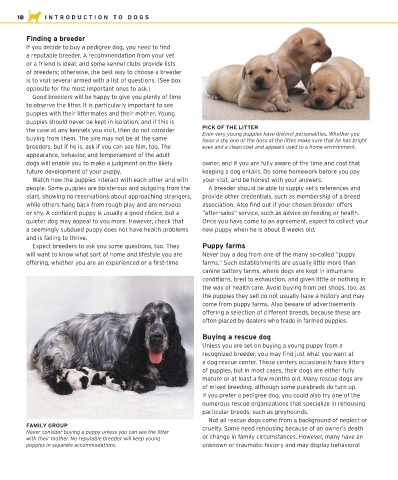
        the case at any kennels you visit, then do not consider   PICK OF THE LITTER
                                                         Even very young puppies have distinct personalities. Whether you
        buying from them. The sire may not be at the same   favor a shy one or the boss of the litter, make sure that he has bright
        breeders, but if he is, ask if you can see him, too. The   eyes and a clean coat and appears used to a home environment.
        appearance, behavior, and temperament of the adult
        dogs will enable you to make a judgment on the likely    owner, and if you are fully aware of the time and cost that
        future development of your puppy.                keeping a dog entails. Do some homework before you pay
          Watch how the puppies interact with each other and with   your visit, and be honest with your answers.
        people. Some puppies are boisterous and outgoing from the   A breeder should be able to supply vet’s references and
        start, showing no reservations about approaching strangers,   provide other credentials, such as membership of a breed
        while others hang back from rough play and are nervous    association. Also find out if your chosen breeder offers
        or shy. A confident puppy is usually a good choice, but a   “after-sales” service, such as advice on feeding or health.
        quieter dog may appeal to you more. However, check that    Once you have come to an agreement, expect to collect your
        a seemingly subdued puppy does not have health problems   new puppy when he is about 8 weeks old.
        and is failing to thrive.
          Expect breeders to ask you some questions, too. They    Puppy farms
        will want to know what sort of home and lifestyle you are   Never buy a dog from one of the many so-called “puppy
        offering, whether you are an experienced or a first-time   farms.” Such establishments are usually little more than
                                                         canine battery farms, where dogs are kept in inhumane
                                                         conditions, bred to exhaustion, and given little or nothing in
                                                         the way of health care. Avoid buying from pet shops, too, as
                                                         the puppies they sell do not usually have a history and may
                                                         come from puppy farms. Also beware of advertisements
                                                         offering a selection of different breeds, because these are
                                                         often placed by dealers who trade in farmed puppies.

                                                         Buying a rescue dog
                                                         Unless you are set on buying a young puppy from a
                                                         recognized breeder, you may find just what you want at
                                                         a dog rescue center. These centers occasionally have litters
                                                         of puppies, but in most cases, their dogs are either fully
                                                         mature or at least a few months old. Many rescue dogs are
                                                         of mixed breeding, although some purebreds do turn up.
                                                         If you prefer a pedigree dog, you could also try one of the
                                                         numerous rescue organizations that specialize in rehousing
                                                         particular breeds, such as greyhounds.
                                                           Not all rescue dogs come from a background of neglect or
        FAMILY GROUP                                     cruelty. Some need rehousing because of an owner’s death
        Never consider buying a puppy unless you can see the litter
        with their mother. No reputable breeder will keep young    or change in family circumstances. However, many have an
        puppies in separate accommodations.              unknown or traumatic history and may display behavioral


   US_018-019_Finding_a_Breeder.indd   18                                                            12/09/19   9:45 AM

