


Page 190 - DK Eyewitness Travel - Guides Ultimate Food Journeys
P. 190
188     ASIA AND AUSTRALASIA


                        The Flavors of


                        Asia and Australasia


                        Asia and Australasia contain virtually half the world’s population and examples of most of the Earth’s geography, so it’s

                        perhaps unsurprising that very few culinary opportunities are left unexplored among this melange of interconnected
                        cultures and climates. Spices dominate the foods of Asia, but are used to flavor a huge range of cuisines with distinctive
                        styles. Australasia has combined these with its European heritage to concoct a unique range of Pan-Asian dishes.


                        In the north of Asia, the arid Himalayan plateau descends to a vast   distance have preserved local variations: a cuisine might be
                        swath of treeless steppes, where wheat is the staple and cooking is   identifiably “Asian,” but there’s a world of difference between a
                        kept simple by the limited ingredients. Lower down, humid hills and   Cambodian amok fish curry and West Lake fish from China’s
                        river plains form the heartland of those two great Asian core crops –     Hangzhou. However, there are definite cooking “families”: Thailand,
                        tea and rice – that pattern the upland slopes in terracing, color    Malaysia, and Indonesia share a southern Indian love of spice pastes,
                        the landscape a rich green, and nourish half of humanity. Rice in   coconut milk, and grilled foods; the cooking of Laos, Cambodia,
                        particular holds the regional cuisines together, infinitely flexible    and Vietnam has clearer, cleaner flavors built around well-defined
                        in its uses: it’s eaten steamed, fried, roasted, and boiled; made into   ingredients, perhaps closer to the studied simplicity and restrained
                                               noodles, cakes, and wine; ground into   palette of Japanese and Korean cuisine. India has no qualms about
                 Thailand, Malaysia, and
                                               flour and used in desserts. The rice   adapting foreign dishes – Mumbai’s cosmopolitan chaat snacks, for
              Indonesia share a southern       belt extends south into the tropics,   example, embrace even Portuguese influences. Even that inward-
               Indian love of spice pastes,    where heat, rain, and rich soils create   looking cultural monolith, China, where alien ideas are absorbed
                                               an extraordinary fertility in which all   so effectively that they eventually become Chinese, still shows
            coconut milk, and grilled foods.
                                               manner of spices, fruits, and vegetables   evidence of contact with the outside world – in Peking duck, for
                        flourish. Add to this the multitudes of farmed pigs and chickens and   instance, which probably owes a debt to Mongol cuisine.
                        an abundance of marine life, and the menu becomes infinite.

                        A Rich Mixture of Cuisines
                        The story of Asian cuisine is one of cross-fertilization. In terms of
                        variety and influence, India and China completely dominate the
                        region. Migration, trade, and conquest spread the philosophies and
                        cuisines of these two behemoths across Asia, though isolation and


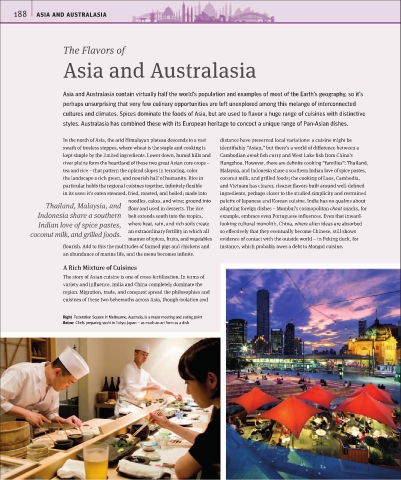
                        Right  Federation Square in Melbourne, Australia, is a major meeting and eating point
                        Below  Chefs preparing sushi in Tokyo, Japan – as much an art form as a dish

