


Page 209 - DK Eyewitness Travel - Guides Ultimate Food Journeys
P. 209
CHENGDU CHINA       207


                                                                                                       The Best Teahouses in
                                                                                                       Sichuan Province

                                                                                         CHENGDU
                                                                                                       Heming Teahouse inexpensive
                                                                                                       Everyone in Chengdu knows Heming Teahouse.
                                                                                                       Set underneath a wisteria vine just inside the
                                                                                                       city’s most central park, this open-air teahouse
            CHENGDU CHINA
                                                                                                       looks out across a large ornamental pond.
                                                                                                       There’s a large bronze kettle at the entrance
            A Cultural Brew in Chengdu                                                                 (actually a water spout for you to wash your
                                                                                                       hands on the way in), the regulation bamboo
                                                                                                       chairs, and some solid, inconveniently shaped
                                                                                                       stone tables. Cruising hairdressers, shoulder
            It’s a summer day in Chengdu, the humid capital of Sichuan province, and people are languishing   masseurs, and even earwax removers move
                                                                                                       among the locals, some of whom seem to spend
            at a riverside teahouse, paralyzed by the heat despite shade from overhanging ginkgo and willow
                                                                                                       the entire day here. There’s just the right blend
            trees. In front of each is a thermos of hot water and a steaming cup of tea – which, according to   of indifference and attention shown to you by
                                                                                                       the staff. Weekend crowds sprawl, chew
            Chinese medicine, is in fact “cooling,” making it the perfect thing to drink in this climate.
                                                                                                       sunflower seeds, and slurp their drinks
                                                                                                       cheerfully, as they gossip, browse their
                          Chengdu, the capital of Sichuan   jasmine or green tea – but other times you may be   newspapers, or stare vacantly at youngsters
                           province, is a modern, overcrowded   offered a three-page menu of regional specialties. Tea is   bumping around in boats on the pond.
                                                                                                         A cafeteria off to one side sells hot and cold
                           metropolis – but patches of   normally served in a gaiwan cha – a squat, lidded cup
                                                                                                       snacks, and once a year there’s a food fair in the
                           traditional culture survive among   and saucer, which is used as a teapot elsewhere in
                                                                                                       park, where you can buy other local treats such
                          the expressways and offices, and   China for pouring the brew into thimble-sized cups, but
                                                                                                       as “three gunshots” – three sticky-rice balls
                        especially in the people. The city dates   here it’s drunk from directly. Locals pick up the whole   that are bounced off a drum into a tray of
            back to prehistory, and became known as a base for   assemblage in one hand to take a sip, carefully holding   toasted flour and served in dark caramel; more
            rebel armies around AD 200, before blossoming   the lid only slightly open to keep back floating leaves.   performance art than a meal.
            as a trading nexus on the “tea-horse roads,” which   Demanding far less skill, zhuye qing, a green tea from   North Gate, Renmin Park, Chengdu; open
                                                                                                       6 AM–7 PM daily
            spread out from central China into distant Tibet by    the forested foothills of holy Mount Emei, always
            the 16th century. Tea has been drunk in China for   arrives in a glass tumbler so that you can watch the
                                                                                                       Also in Eastern Sichuan
            millennia; there are hundreds of varieties of tea and as   tiny, spear-shaped buds rise and fall as the drink cools.
                                                                                                       For a rural riverside setting, leave Chengdu
            many ways of serving it. But teahouse culture – with   The waiter will leave behind a flask of hot water,
                                                                                                       and head to the village of Huanglong Xi,
            teahouses serving as hubs of local communities, like a   or periodically return with a metal kettle. Some
                                                                                                       whose rickety antique streets and low-key
            bar or pub in the West – really only survives nowadays   establishments serve Sichuanese snacks, or at least a
                                                                                                       temples have made it something of a tourist
            in Sichuan, and most obviously in Chengdu.   plate of dried beans or melon seeds so you can munch   phenomenon. For a similar experience with less
               Sichuanese teahouses take many forms, from a    on something as you watch your fellow drinkers chat   raucous crowds, try Pingle, about 55 miles
            few chairs in the corner of a temple park to grand,   idly in the Sichuanese dialect, or play cards or mah   (90 km) west of Chengdu. There are wonderfully
            antique-style buildings with heavy wooden furniture   jong. If the teahouse is a theater, don’t expect the   atmospheric teahouses in Zigong, a former
            and a theater stage for watching Sichuanese opera.   audience to devote too much attention to the play;   industrial town a day’s journey from Chengdu;
                                                                                                       here you can relax over tea in the flagstoned
            Take a seat in either and a waiter will materialize to   they’ll know the story already, and catching up with
                                                                                                       courtyards of Wangye Miao and Huanhou Gong,
            offer you tea; sometimes there’s not much choice – just   friends or swapping stories is far more important.
                                                                                                       two splendidly ornate merchants’ guildhalls
                                                                                                       commemorating the town’s salt-mining heyday.
              Sichuanese Snacks                                                                        Also in Western Sichuan
              Sichuan is famous for the variety of its snacks, or                                      For a totally different take on what makes a
              xiaochi, which, unlike many Sichuanese main                                              good cup of tea in Sichuan, head to western
              courses, are not always searingly spicy. Savory                                          Sichuan. The teahouses scattered through dusty
              “carrypole noodles” (dandan mian) are named                                              backlanes in Songpan – a Qing dynasty
              after the way street hawkers of this dish used to                                        garrison town encircled by stone walls and
              cart their wares around, while gruesome-sounding                                         snowy mountains – make great perches for
              “husband-wife lung slices” (fuqi feipian)                                                watching the Muslim, Tibetan, and Qiang
              feature slivers of beef in a mild soy/vinegar/chili-
                                                                                                       population go about their business. In the
              pepper dressing. Both chao shou (Sichuanese                                              remote monastery towns of Litang and
              ravioli in plain soup) and tangyuan (rice flour
                                                                                                       Langmusi, pluck up the courage to try
              dumplings stuffed with sweet sesame paste) are
              pepper-free, though bland douhua, soft tofu,                                             Tibetan butter tea: a rare mix of tea, yak butter,
              comes with hot relish on the side. Upping the heat                                       salt, and water churned into a soup.
              considerably, gege (rice-coated spare ribs cooked
              in tiny steamers), liang fen (cold bean noodles in
              a chili pepper/vinegar sauce), and ranmian (the
              aptly-named “incandescent noodles”) are best
              avoided unless you have an asbestos mouth.

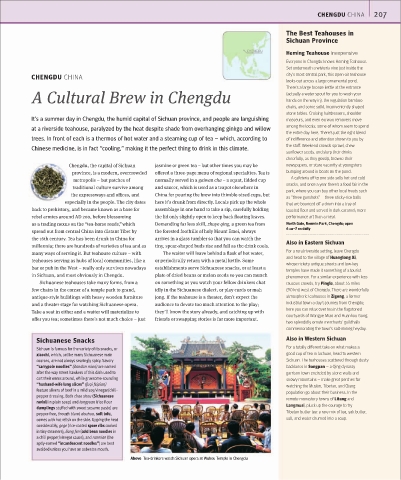
                                                Above  Tea-drinkers watch Sichuan opera at Wuhou Temple in Chengdu

