


Page 249 - DK Eyewitness Travel - Guides Ultimate Food Journeys
P. 249
TOKYO JAPAN      247


                                                                                                       The Best Places to
                                                                                                       Eat Sushi
                                                                                          TOKYO
                                                                                                       Tsukiji Fish Market inexpensive
                                                                                                       There are sushi restaurants in every Tokyo
                                                                                                       neighborhood, ranging from six-seater bars to
                                                                                                       larger chains and conveyor-belt or kaiten sushi
            TOKYO JAPAN
                                                                                                       places. But the spiritual home of sushi are the
                                                                                                       restaurants in the heart of the world-famous
            Fresh Sushi in Towering Tokyo                                                              Tsukiji fish market, the largest fish market in the
                                                                                                       world. The most famous of these restaurants is
                                                                                                       Daiwa, but its neighbors, particularly Sushi Dai,
                                                                                                       are just about as good, and they all serve what
            During the first decade of the 21st century, Tokyo finally edged aside New York, Paris, and   is perhaps the freshest sushi in the world.
                                                                                                       Annoyingly, they don’t take reservations, so you
            London to claim the title of the undisputed culinary capital of the world, and its greatest food is
                                                                                                       need to arrive seriously early (around 5:00 AM) to
            sushi. Whether feasted upon at a lavish members-only restaurant or from a cheap and cheerful   avoid the lines. Set some time aside for a walk
                                                                                                       around the market itself, too, because it is one
            kaiten, where tempting portions roll by on a conveyor belt, the sushi here is invariably delicious.
                                                                                                       of the greatest food sights on Earth. Finally, if
                                                                                                       you want to be guaranteed a sushi meal to
                      Tokyo is one of the world’s great cities,   the idea of squeezing rice into small blocks and adding   remember, there is one word with which you
                         with cultural, historic, and culinary   toppings. This hand-shaped form of sushi became   must greet the chef as you take your seat –
                                                                                                       “Omakase,” which means: “I’ll leave it up to you.”
                          attractions to rival any capital. It is   known as nigiri (meaning “to squeeze”); along with
                                                                                                       Tsukiji, Tokyo; open 5 AM–2 PM Mon–Sat (closed on
                          built on a daunting scale and its   maki rolls (seaweed-bound rice rolls), it was to become
                                                                                                       alternate Weds); www.tsukiji-market.or.jp
                          cityscape changes ceaselessly, but   the best known form of sushi around the world.
            amid the liquid-crystal screens, nonstop rivers of   Now that sushi has become as ubiquitous as   Also in Tokyo
            people, and towering overpasses, there remain pockets   sandwiches in the supermarkets of the West, it can seem
                                                                                                       The Ginza district in Tokyo is home to
            of ancient Japan in the form of the city’s temples and   a little strange to discover that in Tokyo the Japanese   fiendishly expensive, exclusive, and often
            gardens, which are soothing oases of stillness.   don’t really think of it as a cheap fast food. You can buy   impossible-to-get-into sushi restaurants. The
               No one takes food more seriously than the Japanese.   packs of prepared sushi in supermarkets (and it will be   most famous of these is Sukiyabashi Jiro
            Tokyo doesn’t just offer every kind of global food and   better than any supermarket sushi you’ve ever tasted),   (+81 03 3535 3600; expensive), which was
            cuisine imaginable; it aims to better the originals. The   but the Japanese – and Tokyoites in particular – take   awarded three Michelin stars in 2009 and is run
                                                                                                       by the eponymous and legendary 84-year-old
            city has also given the world several great dishes, not   their sushi much more seriously than that. Here, sushi
                                                                                                       Jiro-san. He has been making sushi for over
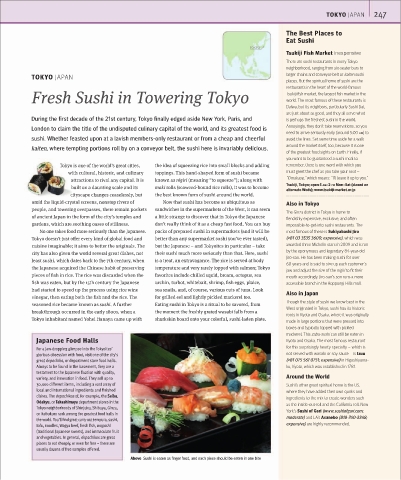
            least sushi, which dates back to the 7th century, when   is a treat, an extravagance. The rice is served at body
                                                                                                       60 years and is said to size up each customer’s
            the Japanese acquired the Chinese habit of preserving   temperature and very rarely topped with salmon; Tokyo
                                                                                                       jaw and adjust the size of the nigiri to fit their
            pieces of fish in rice. The rice was discarded when the   favorites include chilled squid, bream, octopus, sea   mouth accordingly. Jiro-san’s son runs a more
            fish was eaten, but by the 15th century the Japanese   urchin, turbot, whitebait, shrimp, fish eggs, plaice,    accessible branch in the Roppongi Hills mall.
            had started to speed up the process using rice wine   sea snails, and, of course, various cuts of tuna. Look
                                                                                                       Also in Japan
            vinegar, then eating both the fish and the rice. The   for grilled eel and lightly pickled mackerel too.
                                                                                                       Though the style of sushi we know best in the
            seasoned rice became known as sushi. A further   Eating sushi in Tokyo is a ritual to be savored, from
                                                                                                       West originated in Tokyo, sushi has its historic
            breakthrough occurred in the early 1800s, when a   the moment the freshly grated wasabi falls from a
                                                                                                       roots in Kyoto and Osaka, where it was originally
            Tokyo inhabitant named Yohei Hanaya came up with   sharkskin board onto your colorful, sushi-laden plate.
                                                                                                       made in large portions that were pressed into
                                                                                                       boxes and typically topped with pickled
                                                                                                       mackerel. This zaba-sushi can still be eaten in
              Japanese Food Halls                                                                      Kyoto and Osaka. The most famous restaurant
              For a jaw-dropping glimpse into the Tokyoites’                                           for this surprisingly hearty specialty – which is
              glorious obsession with food, visit one of the city’s                                    not served with wasabi or soy sauce – is Izuu
              great depachika, or department store food halls.                                         (+81 075 561 0751; expensive) in Higashiyama-
              Always to be found in the basement, they are a                                           ku, Kyoto, which was established in 1781.
              testament to the Japanese fixation with quality,
              variety, and innovation in food. They sell up to                                         Around the World
              30,000 different items, including a vast array of                                         Sushi’s other great spiritual home is the US,
              local and international ingredients and finished                                          where they have added their own quirks and
              dishes. The depachikas of, for example, the Seibu,                                       ingredients to the mix to create wonders such
              Odakyu, or Takashimaya department stores in the
                                                                                                       as the inside-out-roll and the California roll. New
              Tokyo neighborhoods of Shinjuku, Shibuya, Ginza,                                         York’s Sushi of Gari (www.sushiofgari.com;
              or Ikebukuro rank among the greatest food halls in
                                                                                                       moderate) and LA’s Asanebo (818-760-3348;
              the world. You’ll find great carry-out tempura, sushi,
              tofu, noodles, Wagyu beef, fresh fish, wagashi                                            expensive) are highly recommended.
              (traditional Japanese sweets), and immaculate fruit
              and vegetables. In general, depachikas are great
              places to eat cheaply, or even for free – there are
              usually dozens of free samples offered.

                                                Above  Sushi is eaten as finger food, and each piece should be eaten in one bite

