


Page 316 - DK Eyewitness Travel - Guides Ultimate Food Journeys
P. 316
314     SOUTH AMERICA


                                                                                        CHILOE

            CHILOE CHILE

            A Fine Feast in Southern Chile


            An enchanted island archipelago, Chiloé is a bewitching place of silent forests and craggy peaks
            that tumble down to fishing villages and mist-shrouded bays. Once believed to be a place of
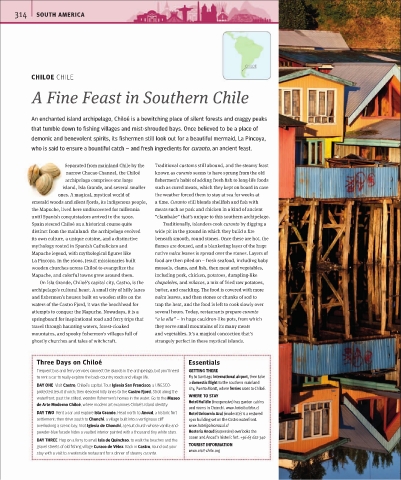
            demonic and benevolent spirits, its fishermen still look out for a beautiful mermaid, La Pincoya,
            who is said to ensure a bountiful catch – and fresh ingredients for curanto, an ancient feast.


                        Separated from mainland Chile by the   Traditional customs still abound, and the steamy feast
                         narrow Chacao Channel, the Chiloé   known as curanto seems to have sprung from the old
                        archipelago comprises one large   fishermen’s habit of adding fresh fish to long-life foods
                       island, Isla Grande, and several smaller   such as cured meats, which they kept on board in case
                      ones. A magical, mystical world of   the weather forced them to stay at sea for weeks at
            emerald woods and silent fjords, its indigenous people,   a time. Curanto still blends shellfish and fish with
            the Mapuche, lived here undiscovered for millennia   meats such as pork and chicken in a kind of ancient
            until Spanish conquistadors arrived in the 1500s.   “clambake” that’s unique to this southern archipelago.
            Spain steered Chiloé on a historical course quite   Traditionally, islanders cook curanto by digging a
            distinct from the mainland: the archipelago evolved    wide pit in the ground in which they build a fire
            its own culture, a unique cuisine, and a distinctive   beneath smooth, round stones. Once these are hot, the
            mythology rooted in Spanish Catholicism and   flames are doused, and a blanketing layer of the huge
            Mapuche legend, with mythological figures like    native nalca leaves is spread over the stones. Layers of
            La Pincoya. In the 1600s, Jesuit missionaries built   food are then piled on – fresh seafood, including baby
            wooden churches across Chiloé to evangelize the   mussels, clams, and fish, then meat and vegetables,
            Mapuche, and colorful towns grew around them.     including pork, chicken, potatoes, dumpling-like
               On Isla Grande, Chiloé’s capital city, Castro, is the   chapaleles, and milacos, a mix of fried raw potatoes,
            archipelago’s cultural heart. A small city of hilly lanes   butter, and crackling. The food is covered with more
            and fishermen’s houses built on wooden stilts on the   nalca leaves, and then stones or chunks of sod to
            waters of the Castro Fjord, it was the beachhead for   trap the heat, and the food is left to cook slowly over
            attempts to conquer the Mapuche. Nowadays, it is a   several hours. Today, restaurants prepare curanto
            springboard for inspirational road and ferry trips that   “a la olla” – in huge cauldron-like pots, from which
            travel through haunting waters, forest-cloaked   they serve small mountains of its many meats
            mountains, and spooky fishermen’s villages full of   and vegetables. It’s a magical concoction that’s
            ghostly churches and tales of witchcraft.    strangely perfect in these mystical islands.


              Three Days on Chiloé                                  Essentials
              Frequent bus and ferry services connect the islands in the archipelago, but you’ll need   GETTING THERE
              to rent a car to really explore the back-country roads and village life.   Fly to Santiago international airport, then take
                                                                    a domestic flight to the southern mainland
              DAY ONE  Visit Castro, Chiloé’s capital. Tour Iglesia San Francisco, a UNESCO-
                                                                    city, Puerto Montt, where ferries cross to Chiloé.
              protected Jesuit church; then descend hilly lanes to the Castro Fjord. Stroll along the
                                                                    WHERE TO STAY
              waterfront, past the stilted, wooden fishermen’s homes in the water. Go to the Museo
                                                                    Hotel Huildin (inexpensive) has garden cabins
              de Arte Moderno Chiloé, where modern art examines Chiloé’s island identity.
                                                                    and rooms in Chonchi. www.hotelhuildin.cl
              DAY TWO  Rent a car and explore Isla Grande. Head north to Ancud, a historic fort   Hotel Unicornio Azul (moderate) is a restored
              settlement; then drive south to Chonchi, a village built into a vertiginous cliff   1910 building set on the Castro waterfront.
              overlooking a scenic bay. Visit Iglesia de Chonchi, a Jesuit church whose vanilla-and-  www.hotelgaleonazul.cl
              powder-blue facade hides a vaulted interior painted with a thousand tiny white stars.  Hostería Ancud (expensive) overlooks the
                                                                    ocean and Ancud’s historic fort. +56 65 622 340
              DAY THREE  Hop on a ferry to small Isla de Quinchao, to walk the beaches and the
                                                                    TOURIST INFORMATION
              gravel streets of old fishing village Curaco de Vélez. Back in Castro, round out your
                                                                    www.visit-chile.org
              stay with a visit to a waterside restaurant for a dinner of steamy curanto.

