


Page 36 - DK Eyewitness Travel - Guides Ultimate Food Journeys
P. 36
34    EUROPE


                                                                                     BRITTANY


            BRITTANY FRANCE

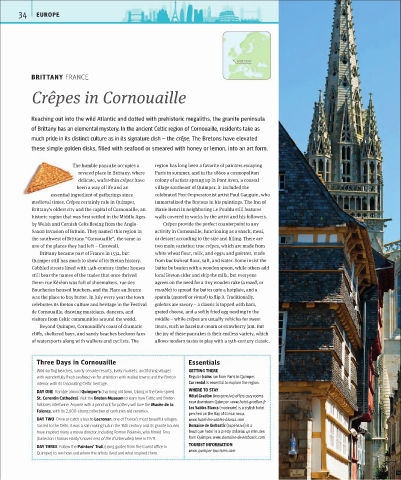
            Crêpes in Cornouaille


            Reaching out into the wild Atlantic and dotted with prehistoric megaliths, the granite peninsula
            of Brittany has an elemental mystery. In the ancient Celtic region of Cornouaille, residents take as
            much pride in its distinct culture as in its signature dish – the crêpe. The Bretons have elevated
            these simple golden disks, filled with seafood or smeared with honey or lemon, into an art form.


                           The humble pancake occupies a   region has long been a favorite of painters escaping
                             revered place in Brittany, where   Paris in summer, and in the 1860s a cosmopolitan
                             delicate, wafer-thin crêpes have   colony of artists sprang up in Pont Aven, a coastal
                            been a way of life and an   village southeast of Quimper. It  included the
                   essential ingredient of gatherings since   celebrated Post-Impressionist artist Paul Gauguin, who
            medieval times. Crêpes certainly rule in Quimper,   immortalized the Bretons in his paintings. The Inn of
            Brittany’s oldest city and the capital of Cornouaille, an   Marie Henri in neighboring Le Pouldu still features
            historic region that was first settled in the Middle Ages   walls covered in works by the artist and his followers.
            by Welsh and Cornish Celts fleeing from the Anglo-  Crêpes provide the perfect counterpoint to any
            Saxon invasion of Britain. They named this region in   activity in Cornouaille, functioning as a snack, meal,
            the southwest of Brittany “Cornouaille”, the same as   or dessert according to the size and filling. There are
            one of the places they had left – Cornwall.   two main varieties: true crêpes, which are made from
               Brittany became part of France in 1532, but   white wheat flour, milk, and eggs; and galettes, made
            Quimper still has much to show of its Breton history.   from buckwheat flour, salt, and water. Some insist the
            Cobbled streets lined with 14th-century timber houses   batter be beaten with a wooden spoon, while others add
            still bear the names of the trades that once thrived   local Breton cider and skip the milk, but everyone
            there: rue Kèrèon was full of shoemakers, rue des   agrees on the need for a tiny wooden rake (a rozell, or
            Boucheries housed butchers, and the Place au Beurre   rouable) to spread the batter onto a hotplate, and a
            was the place to buy butter. In July every year the town   spatula (spanell or viroué) to flip it. Traditionally,
            celebrates its Breton culture and heritage in the Festival   galettes are savory – a classic is topped with ham,
            de Cornouaille, drawing musicians, dancers, and   grated cheese, and a softly fried egg nestling in the
            visitors from Celtic communities around the world.   middle – while crêpes are usually vehicles for sweet
               Beyond Quimper, Cornouaille’s coast of dramatic   treats, such as hazelnut cream or strawberry jam. But
            cliffs, sheltered bays, and sandy beaches beckons fans   the joy of these pancakes is their endless variety, which
            of watersports along with walkers and cyclists. The   allows modern tastes to play with a 15th-century classic.


              Three Days in Cornouaille                             Essentials
              Wild surfing beaches, sandy seaside resorts, lively markets, and fishing villages    GETTING THERE
              with wonderfully fresh seafood vie for attention with walled towns and the Breton   Regular trains run from Paris to Quimper.
              interior with its fascinating Celtic heritage.        Car rental is essential to explore the region.
              DAY ONE  Ramble around Quimper’s charming old town, taking in the twin-spired   WHERE TO STAY
                                                                    Hôtel Gradlon (inexpensive) offers cozy rooms
              St. Corentin Cathedral. Visit the Breton Museum to learn how Celtic and Breton
                                                                    near downtown Quimper. www.hotel-gradlon.fr
              folklores intertwine. Anyone with a penchant for pottery will love the Musèe de la
                                                                    Les Sables Blancs (moderate) is a stylish hotel
              Faïence, with its 2,000-strong collection of centuries-old ceramics.
                                                                    perched on the Bay of Concarneau.
              DAY TWO  Drive or catch a bus to Locronan, one of France’s most beautiful villages.   www.hotel-les-sables-blancs.com
              Sacred to the Celts, it was a sail-making hub in the 16th century and its granite houses   Domaine de Kerbastic (expensive) is a
              have inspired many a movie director, including Roman Polanski, who filmed Tess   boutique hotel in a pretty château 40 minutes
              (based on Thomas Hardy’s novel Tess of the d’Urbervilles) here in 1979.  from Quimper. www.domaine-de-kerbastic.com
                                                                    TOURIST INFORMATION
              DAY THREE  Follow the Painters’ Trail (using guides from the tourist office in
                                                                    www.quimper-tourisme.com
              Quimper) to see how and where the artists lived and what inspired them.

