


Page 86 - DK Eyewitness Travel - Guides Ultimate Food Journeys
P. 86
84     EUROPE


                                                                                      YORK


            YORK ENGLAND

            Afternoon Tea in Historic York


            To the English, tea is more than a drink – it is the universal pick-me-up, the “cup that cheers.”
            Combined with scones, sandwiches, and cakes, the English afternoon tea – served with near-
            ceremonial reverence – approaches an art form. There’s nowhere better to indulge in this
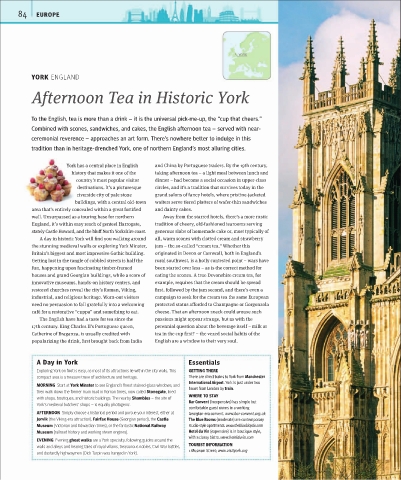
            tradition than in heritage-drenched York, one of northern England’s most alluring cities.


                         York has a central place in English   and China by Portuguese traders. By the 19th century,
                           history that makes it one of the   taking afternoon tea – a light meal between lunch and
                            country’s most popular visitor   dinner – had become a social occasion in upper-class
                             destinations. It’s a picturesque   circles, and it’s a tradition that survives today in the
                             riverside city of pale stone   grand salons of fancy hotels, where pristine-jacketed
                            buildings, with a central old-town   waiters serve tiered platters of wafer-thin sandwiches
            area that’s entirely concealed within a great fortified   and dainty cakes.
            wall. Unsurpassed as a touring base for northern   Away from the starred hotels, there’s a more rustic
            England, it’s within easy reach of genteel Harrogate,   tradition of cheery, old-fashioned tearooms serving
            stately Castle Howard, and the bluff North Yorkshire coast.  generous slabs of homemade cake or, most typically of
               A day in historic York will find you walking around   all, warm scones with clotted cream and strawberry
            the stunning medieval walls or exploring York Minster,   jam – the so-called “cream tea.” Whether this
            Britain’s biggest and most impressive Gothic building.   originated in Devon or Cornwall, both in England’s
            Getting lost in the tangle of cobbled streets is half the   rural southwest, is a hotly contested point – wars have
            fun, happening upon fascinating timber-framed   been started over less – as is the correct method for
            houses and grand Georgian buildings, while a score of   eating the scones. A true Devonshire cream tea, for
            innovative museums, hands-on history centers, and   example, requires that the cream should be spread
            restored churches reveal the city’s Roman, Viking,   first, followed by the jam second, and there’s even a
            industrial, and religious heritage. Worn-out visitors   campaign to seek for the cream tea the same European
            need no persuasion to fall gratefully into a welcoming   protected status afforded to Champagne or Gorgonzola
            café for a restorative “cuppa” and something to eat.  cheese. That an afternoon snack could arouse such
               The English have had a taste for tea since the    passions might appear strange, but as with the
            17th century. King Charles II’s Portuguese queen,   perennial question about the beverage itself – milk or
            Catherine of Braganza, is usually credited with   tea in the cup first? – the vexed social habits of the
            popularizing the drink, first brought back from India   English are a window to their very soul.


              A Day in York                                         Essentials
              Exploring York on foot is easy, as most of its attractions lie within the city walls. This   GETTING THERE
              compact area is a treasure trove of architecture and heritage.  There are direct trains to York from Manchester
                                                                    International Airport. York is just under two
              MORNING  Start at York Minster to see England’s finest stained-glass windows, and
                                                                    hours from London by train.
              then walk down the former main road in Roman times, now called Stonegate, lined
                                                                    WHERE TO STAY
              with shops, boutiques, and historic buildings. The nearby Shambles – the site of
                                                                    Bar Convent (inexpensive) has simple but
              York’s medieval butchers’ shops – is equally photogenic.
                                                                    comfortable guest rooms in a working
              AFTERNOON  Simply choose a historical period and pursue your interest, either at   Georgian-era convent. www.bar-convent.org.uk
              Jorvik (the Viking-era attraction), Fairfax House (Georgian period), the Castle   The Blue Rooms (moderate) are contemporary
              Museum (Victorian and Edwardian times), or the fantastic National Railway   studio-style apartments. www.thebluebicycle.com
              Museum (railroad history and working steam engines).  Hotel du Vin (expensive) is in boutique style,
                                                                    with a classy bistro. www.hotelduvin.com
              EVENING  Evening ghost walks are a York specialty, following guides around the
                                                                    TOURIST INFORMATION
              walls and alleys and hearing tales of royal villains, treasonous nobles, Civil War battles,
                                                                    1 Museum Street; www.visityork.org
              and dastardly highwaymen (Dick Turpin was hanged in York).

