


Page 20 - All About History - Issue 58-17
P. 20
HAIR & BEAUTY


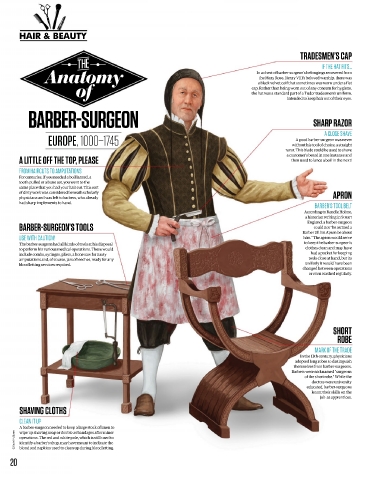
                                                                                                           TRADESMEN’SCAP

                                                                                                                  IFTHEHATFITS…
                            THE
                 Anatomy                                                                   In a chest of barber-surgeon’s belongings recovered from
                                                                                            the Mary Rose, Henry VIII’s beloved warship, there was
                                                                                            a black velvet coif that sometimes was worn under a flat
                            of                                                           cap. Rather than being worn out of any concern for hygiene,
                                                                                         the hat was a standard part of a Tudor tradesmen’s uniform,
                                                                                                      intended to keep hair out of their eyes.

           BARBER-SURGEON                                                                                      SHARP RAZOR


                                                                                                                   ACLOSESHAVE
                                                                                                         A good barber-surgeon was never
                                                                                                        without his tool of choice, a straight
                                                                                                     razor. This blade could be used to shave
                                                                                                      a customer’s beard in one instance and
        ALITTLEOFFTHETOP,PLEASE                                                                        then used to lance a boil in the next!
        FROM HAIRCUTS TO AMPUTATIONS
        For centuries, if you needed a boil lanced, a
        tooth pulled or a bone set, you went to the
        same place that you had your hair cut. This sort
        of dirty work was considered beneath scholarly                                                                APRON
        physicians and was left to barbers, who already
        had sharp implements to hand.
                                                                                                                BARBER’STOOLBELT
                                                                                                            According to Randle Holme,
                                                                                                            a historian writing in Stuart
                                                                                                             England, a barber-surgeon
                                                                                                               could not “be termed a
        BARBER-SURGEON’S TOOLS
                                                                                                           Barber till his Apron be about
        USEWITHCAUTION!                                                                                     him.” The apron would serve
        Thebarber-surgeonhadallkindsoftoolsathisdisposal                                                    to keep the barber-surgeon’s
        to perform his various medical operations. These would                                              clothes clean and may have
        include combs, syringes, pliers, a bone saw for nasty                                                 had a pocket for keeping
        amputations and, of course, jars of leeches, ready for any                                           tools close at hand, but its
        bloodletting services required.                                                                     unlikely it would have been
                                                                                                           changed between operations
                                                                                                              or even washed regularly.


                                                                                                                      SHORT
                                                                                                                        ROBE

                                                                                                                MARK OF THE TRADE
                                                                                                           In the 13th century, physicians
                                                                                                         adopted long robes to distinguish
                                                                                                        themselves from barber-surgeons.
                                                                                                        Barbers were nicknamed “surgeons
                                                                                                            of the short robe.” While the
                                                                                                               doctors were university
                                                                                                             educated, barber-surgeons
                                                                                                               learnt their skills on the
                                                                                                                 job  as apprentices.
        SHAVINGCLOTHS

        CLEAN IT UP
        A barber-surgeon needed to keep a large stock of linen to
      ©KevinMcGivern  operations. The red and white pole, which is still used to
        wipe up shaving soap or double as bandages after minor
        identify a barber’s shop, may have meant to indicate the
        blood and napkins used to clean up during bloodletting.


     20

