


Page 71 - All About History - Issue 58-17
P. 71
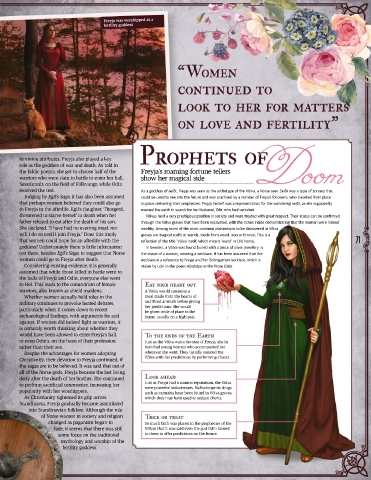
Freyja was worshipped as a
                                      fertility goddess


        feminine attributes, Freyja also played a key
        role as the goddess of war and death. As told in
        the Eddic poems, she got to choose half of the   Freyja’s roaming fortune tellers                  oom
        warriors who were slain in battle to enter her hall,   show her magical side
        Sessrúmnir, on the field of Fólkvangr, while Odin
        received the rest.                         As a goddess of aeiðr, Freyja was seen as the archetype of the Völva, a Norse seer. Seiðr was a type of sorcery that
          Judging by Egil’s Saga, it has also been assumed   could be used to see into the future and was practised by a number of Freya’s followers, who travelled from place
        that perhaps women believed they could also go   to place delivering their prophecies. Freyja herself was a representation for the wandering seiðr, as she supposedly
        to Freyja in the afterlife. Egil’s daughter, Thorgerd,   roamed the earth in search for her husband, Oðr, who had vanished.
        threatened to starve herself to death when her   Völvas held a very prestigious position in society and were treated with great respect. Their status can be confirmed
        father refused to eat after the death of his son.   through the Völva graves that have been excavated, with the riches inside demonstrating that the women were indeed
        She declared, “I have had no evening meal, nor   wealthy. Among some of the most common possessions to be discovered in Völva
        will I do so until I join Freyja.” Does this imply   graves are magical staffs or wands, made from wood, iron or bronze. This is a
        that women could hope for an afterlife with the   reflection of the title ‘Völva’ itself, which means ‘wand’ in Old Norse.
                                                                                                                              71
        goddess? Unfortunately there is little information   In Sweden, a Völva was found buried with a piece of silver jewellery in
        out there, besides Egil’s Saga, to suggest that Norse   the shape of a woman, wearing a necklace. It has been assumed that the
        women could go to Freyja after death.      necklace is a reference to Freyja and her Brísingamen necklace, which is
          Considering existing evidence, it is generally   stolen by Loki in the poem Húsdrápa in the Prose Edda.
        assumed that while those killed in battle went to
        the halls of Freyja and Odin, everyone else went
        to Hel. This leads to the conundrum of female
        warriors, also known as shield maidens.     AVölvawouldconsumea
          Whether women actually held roles in the   meal made from the hearts of
        military continues to provoke heated debates,   sacrificed animals before giving
                                                    her predictions. She would
        particularly when it comes down to recent
                                                    be given pride of place in the
        archaeological findings, with arguments for and   home, usually on a high seat.
        against. If women did indeed fight as warriors, it
        is certainly worth thinking about whether they
        would have been allowed to enter Freyja’s hall,
        or even Odin’s, on the basis of their profession   JustastheVölvawasadevoteeofFreyja,shein
        rather than their sex.                      turn had young women who accompanied her
          Despite the advantages for women adopting   wherever she went. They usually assisted the
                                                    Völva with her predictions by performing chants.
        Christianity, their devotion to Freyja continued, if
        the sagas are to be believed. It was said that out of
        all of the Norse gods, Freyja became the last living
        deity after the death of her brother. She continued
                                                    Just as Freyja had a wanton reputatiom, the Völva
        to perform sacrificial ceremonies, increasing her
                                                    were powerful seductresses. Hallucinogenic drugs
        popularity with her worshippers.            such as cannabis have been found in Völva graves,
                      g
          As Christianity tightened its grip across   which they may have used to seduce clients.
           di
        Sc Scandinavia, Freyja gra adually became assimilated
           into Scandinavian  folklore. Although the role
               of Norse w  en in society and religion
                  changed a as paganism began to    So much faith was placed in the prophecies of the
                    fade, it  seems that there was still   VölvasthatitwassaideventhegodOdinturned
                     some e focus on the traditional   to them to offer predictions on the future.
                      myt hology and worship of the
                       ferti ility goddess.

