


Page 294 - (DK Eyewitness) Travel Guide - USA
P. 294
292 FL ORID A
in the 1920s, which has an
excellent collection of fine and
decorative arts.
Between Washington and
Drexel Avenues is Española
Way, a small, pretty enclave of
Mediterranean Revival
buildings, where ornate arches,
capitals, and balconies adorn
salmon-colored, stuccoed
frontages. Built from 1922–25,
this street is said to be the
inspiration for Addison Mizner’s
Worth Avenue in Palm Beach
(see p301). Offbeat art galleries
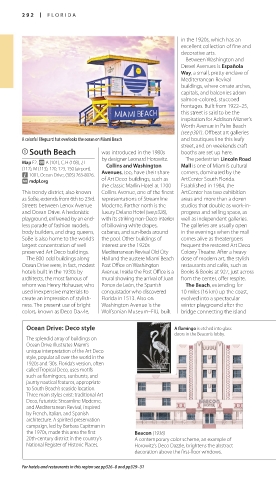
A colorful lifeguard hut overlooks the ocean on Miami Beach and boutiques line this leafy
street, and on weekends craft
1 South Beach was introduced in the 1980s booths are set up here.
by designer Leonard Horowitz. The pedestrian Lincoln Road
Map F2. @ A (101), C, H (108), J, L
(112), M (113), 120, 123, 150 (airport). Collins and Washington Mall is one of Miami’s cultural
n 1001, Ocean Drive, (305) 763-8026. Avenues, too, have their share corners, dominated by the
∑ mdpl.org of Art Deco buildings, such as ArtCenter South Florida.
the classic Marlin Hotel at 1200 Established in 1984, the
This trendy district, also known Collins Avenue, one of the finest ArtCenter has two exhibition
as SoBe, extends from 6th to 23rd representations of Streamline areas and more than a dozen
Streets between Lenox Avenue Moderne. Farther north is the studios that double as work-in-
and Ocean Drive. A hedonistic luxury Delano Hotel (see p326), progress and selling space, as
playground, enlivened by an end- with its striking non-Deco interior well as independent galleries.
less parade of fashion models, of billowing white drapes, The galleries are usually open
body builders, and drag queens, cabanas, and sun-beds around in the evenings when the mall
SoBe is also home to the world’s the pool. Other buildings of comes alive as theatergoers
largest concen tration of well- interest are the 1920s frequent the restored Art Deco
preserved Art Deco buildings. Mediterranean Revival Old City Colony Theatre. After a heavy
The 800-odd buildings along Hall and the austere Miami Beach dose of modern art, the stylish
Ocean Drive were, in fact, modest Post Office on Washington restaurants and cafés, such as
hotels built in the 1930s by Avenue. Inside the Post Office is a Books & Books at 927, just across
architects, the most famous of mural showing the arrival of Juan from the center, offer respite.
whom was Henry Hohauser, who Ponce de León, the Spanish The Beach, extending for
used inexpensive materials to conquistador who discovered 10 miles (16 km) up the coast,
create an impression of stylish- Florida in 1513. Also on evolved into a spectacular
ness. The present use of bright Washington Avenue is the winter playground after the
colors, known as Deco Dazzle, Wolfsonian Museum–FIU, built bridge connecting the island
Ocean Drive: Deco style A flamingo is etched into glass
doors in the Beacon’s lobby.
The splendid array of buildings on
Ocean Drive illustrates Miami’s
unique interpretation of the Art Deco
style, popular all over the world in the
1920s and ’30s. Florida’s version, often
called Tropical Deco, uses motifs
such as flamingoes, sunbursts, and
jaunty nautical features, appropriate
to South Beach’s seaside location.
Three main styles exist: traditional Art
Deco, futuristic Streamline Moderne,
and Mediterranean Revival, inspired
by French, Italian, and Spanish
architecture. A spirited preservation
campaign, led by Barbara Capitman in
the 1970s, made this area the first Beacon (1936)
20th-century district in the country’s A contemporary color scheme, an example of
National Register of Historic Places. Horowitz’s Deco Dazzle, brightens the abstract
decoration above the first-floor windows.
For hotels and restaurants in this region see pp326–8 and pp329–31
292-293_EW_USA.indd 292 11/3/16 10:59 AM

