


Page 305 - (DK Eyewitness) Travel Guide - USA
P. 305
ORLANDO & THE SP A CE C O AST 303
attraction that teaches physics see alligators and the
and engineering through video endangered manatee, but the
games. There are two special- highlight is the rich birdlife.
interest tours – Discover KSC: The Canaveral National
Today and Tomorrow, an Seashore has a pristine 24-mile
insider’s view of the entire space (39-km) stretch of beach. Apollo
shuttle program, and the Cape Beach at the northern end, and
Canaveral: Then & Now Tour, Playalinda Beach to the south
an expedition to the Mercury, are fine for sunbathing, but
Gemini, and Apollo launch pads. swimming can be hazardous,
It takes visitors to the Air Force and there are no lifeguards.
Space & Missile Museum, where The top of Turtle Mound offers
America’s first satellite was splendid views of Mosquito
launched, then to the launch Lagoon (aptly named, so be
complex where Alan Shepard sure to bring repellent in spring
lifted-off on America’s first and summer).
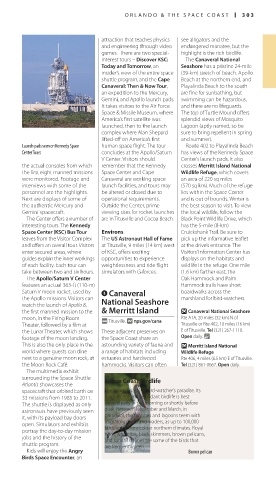
Launch pads seen on Kennedy Space human space flight. The tour Route 402 to Playalinda Beach
Center Tours concludes at the Apollo/Saturn has views of the Kenn edy Space
V Center. Visitors should Center’s launch pads. It also
the actual consoles from which remember that the Kennedy crosses Merritt Island National
the first eight manned missions Space Center and Cape Wildlife Refuge, which covers
were monitored. Footage and Canaveral are working space an area of 220 sq miles
interviews with some of the launch facilities, and tours may (570 sq km). Much of the refuge
personnel are the highlights. be altered or closed due to lies within the Space Center
Next are displays of some of operational requirements. and is out of bounds. Winter is
the authentic Mercury and Outside the Center, prime the best season to visit. To view
Gemini spacecraft. viewing sites for rocket launches the local wildlife, follow the
The Center offers a number of are in Titusville and Cocoa Beach. Black Point Wildlife Drive, which
interesting tours. The Kennedy has the 5-mile (8-km)
Space Center (KSC) Bus Tour Environs Cruickshank Trail. Be sure to
leaves from the Visitor Complex The US Astronaut Hall of Fame pick up the informative leaflet
and offers an overall tour. Visitors at Titusville, 9 miles (14 km) west at the drive’s entrance. The
enter secured areas, where of KSC, offers exciting Visitors’ Information Center has
guides explain the inner workings opportunities to experience displays on the habitats and
of each facility. Each tour can weightlessness and ride flight wildlife in the refuge. One mile
take between two and six hours. simulators with G-forces. (1.6 km) farther east, the
The Apollo/Saturn V Center Oak Hammock and Palm
features an actual 363-ft (110-m) Hammock trails have short
Saturn V moon rocket, used by 8 Canaveral boardwalks across the
the Apollo missions. Visitors can National Seashore marshland for bird-watchers.
watch the launch of Apollo 8,
the first manned mission to the & Merritt Island O Canaveral National Seashore
moon, in the Firing Room @ Titusville. ∑ nps.gov/cana Rte A1A, 20 miles (32 km) N of
Theater, followed by a film at Titusville or Rte 402, 10 miles (16 km)
the Lunar Theater, which shows These adjacent preserves on E of Titusville. Tel (321) 267-1110.
footage of the moon landing. the Space Coast share an Open daily. &
This is also the only place in the astounding variety of fauna and O Merritt Island National
world where guests can dine a range of habitats inclu ding Wildlife Refuge
next to a genuine moon rock, at estuaries and hardwood Rte 406, 4 miles (6.5 km) E of Titusville.
the Moon Rock Café. hammocks. Visitors can often Tel (321) 861-0667. Open daily.
The multi media exhibit
surrounding the Space Shuttle Space Coast Birdlife
Atlantis showcases the
spacecraft that orbited Earth on The Space Coast is a bird-watcher’s paradise. Its
33 missions from 1985 to 2011. magnificent and abundant birdlife is best
The shuttle is displayed as only viewed early in the morning or shortly before
astronauts have previously seen dusk. Between November and March, in
it, with its payload bay doors particular, the marshes and lagoons teem with
open. Simulators and exhibits migratory ducks and waders, as up to 100,000
portray the day-to-day mission birds arrive from colder northern climates. Royal
terns, white ibis, black skimmers, brown pelicans,
jobs and the history of the and sandhill cranes are some of the birds that
shuttle program. are frequently seen.
Kids will enjoy the Angry Brown pelican
Birds Space Encounter, an
USA_302-ED047-1033_FL2CAT.indd 303 17/11/2016 10:34

