


Page 323 - (DK Eyewitness) Travel Guide - USA
P. 323
THE GULF C O AST & THE E VERGLADES 321
l Everglades pineapple family that grow on Florida Bay and are especially
National Park other plants, and the trail’s rich in birdlife. Flamingo offers
namesake, the gumbo-limbo a wide choice of activ ities
Open daily. n all centers open Dec– tree with its red bark. such as hiking, fishing, boating,
Apr: daily; check for rest of year. Ernest A short distance to the west, and wildlife viewing. An
F. Coe Visitor Center: Tel (305) 242- Long Pine Key’s campsite is overnight stay at the campsite
7700. Open 24 hours daily all year. beautifully situated and is one is a must, especially for bird-
Gulf Coast Visitor Center: (Everglades
City) Tel (239) 695-3311; boat tours & of the main reasons that people watching. The bays around
canoe rental (239) 695-2591. Shark stop here. Several shady trails Flamingo have manatees
Valley Information Center: Tel (305) lead off from it: do not stray (see p319), as well as the rare,
221-8776; tram tours & cycle rental from the paths as the limestone endangered American croco-
(305) 221-8455. Royal Palm Visitor bed- rock has “solution holes” dile. The Flamingo Visitor
Center: Tel (305) 242-7700. Flamingo created by rain, which are Center has information
Visitor Center: Tel (239) 695-2945. For deep and difficult to spot. about ranger-led activities:
canoe, bicycle rental & boat tours, call Shark Valley lies north of talks, slideshows, and
(239) 695-3101. 7 most boardwalks Long Pine Key, near the park walks through the swamp.
are accessible. (800) 365-2267 to boundary. The area is best Canoeing is the best way
book. ∑ nps.gov/ever visited by taking a tram tour to explore the watery trails
or a bicycle along the around Flamingo. These
Covering 1.4 million acres 15-mile (25-km) loop road. range from short trips to a
(566,580 ha), the Everglades A 60-ft (18-m) tower at its week-long adventure of
National Park makes up only end offers great views. Park ranger the remote Wilderness
a fifth of the world-famous The valley is home to the Waterway, leading past
Everglades – low-lying wetlands Seminole Indians, who settled Whitewater Bay along the park’s
formed from the overspill of here in the 19th-century after western coast. Northwest of
Lake Okeechobee. The unique being driven into the Flamingo, the park’s western
landscape consists of a vast Everglades by land-hungry entrance is marked by the
expanse of sawgrass prairie, Europeans (see p286). island of Chokoloskee.
broken by tree islands, The elevated Pa-hay-okee Today, the Everglades are
hammocks, and meandering Overlook lies northwest of Long under stress due to a disrupted
channels. A paradise for wildlife, Key Pine. The expanse of saw- flow of water, which could
the park has a wide range of grass prairie seen from here is prove disastrous for this
fauna, including 400 species typical of the Everglades land- delicate ecosystem. However,
of birds. scape. The view from the work has been underway to
The main entrance lies observation tower is worth the restore the environment and
10 miles (16 km) west of Florida climb: tree islands break the rectify the damages caused.
City. Inside are walking trails, horizon, and a multitude of birds, Visitors should follow a few,
most of them elevated such as hawks, roseate spoon- simple safety tips. Bring insect
boardwalks; some are suitable bills, great blue herons, and repellent and protection
for bicycles. Boats and canoes snail kites, can be easily spotted. against the sun. Follow park
can be rented. The best time The Mahogany Hammock rules and respect all wildlife.
to visit is during winter. South of Trail leads through one of the Note that some shrubs and
the main entrance lies the park’s largest hammocks, trees are poisonous, as are
informative Royal Palm Visitor and it has a variety of fauna some caterpillars, spiders, and
Center and two boardwalk trails. and flora. Trails such as West snakes. Do not wander off the
The popular Anhinga Trail Lake Trail and Snake Bight pathways, and drive slowly
attracts wildlife in the dry winter Trail lie between Mahogany because animals often venture
months, and its open site is Hammock and Flamingo on onto the road.
excellent for photographs.
Alligators congregate at the
“gator hole” (a pond that is
hollowed out by alligators in
the dry season to reach the
water below) at the head of
the trail, and a wide range of
fauna, including deer, raccoons,
and the splendid anhinga bird,
can be spotted. Close by, the
Gumbo Limbo Trail offers the
best chance to explore a
tropical hardwood hammock
but is ridden with mosquitoes.
Watch for the pretty bromeliads,
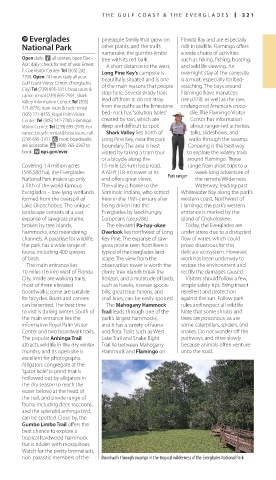
non-parasitic members of the Boardwalk through swamps in the tropical wilderness of the Everglades National Park
320-321_EW_USA.indd 321 11/2/16 2:45 PM

