


Page 340 - (DK Eyewitness) Travel Guide - USA
P. 340
338 THE DEEP SOUTH
tribes. A century later, the Creeks
themselves were under assault, and
by 1816 they had been forced to
give up their vast and fertile
territory to the incoming settlers.
The story of most other Deep South
tribes is similar, ending tragically in
the 1830s, when they were moved
to distant Oklahoma.
While English-speaking Americans
dominate the past and present,
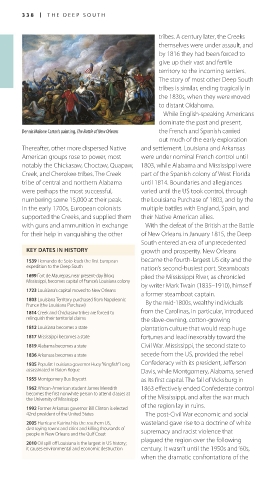
Dennis Malone Carter’s painting, The Battle of New Orleans the French and Spanish carried
out much of the early exploration
Thereafter, other more dispersed Native and settlement. Louisiana and Arkansas
American groups rose to power, most were under nominal French control until
notably the Chickasaw, Choctaw, Quapaw, 1803, while Alabama and Mississippi were
Creek, and Cherokee tribes. The Creek part of the Spanish colony of West Florida
tribe of central and northern Alabama until 1814. Boundaries and allegiances
were perhaps the most successful, varied until the US took control, through
numbering some 15,000 at their peak. the Louisiana Purchase of 1803, and by the
In the early 1700s, European colonists multiple battles with England, Spain, and
supported the Creeks, and supplied them their Native American allies.
with guns and ammunition in exchange With the defeat of the British at the Battle
for their help in vanquishing the other of New Orleans in January 1815, the Deep
South entered an era of unprecedented
KEY DATES IN HISTORY growth and prosperity. New Orleans
1539 Hernando de Soto leads the first European became the fourth-largest US city and the
expedition to the Deep South nation’s second-busiest port. Steamboats
1699 Fort de Maurepas, near present-day Biloxi, plied the Mississippi River, as chronicled
Mississippi, becomes capital of France’s Louisiana colony
by writer Mark Twain (1835–1910), himself
1723 Louisiana’s capital moved to New Orleans
a former steamboat captain.
1803 Louisiana Territory purchased from Napoleonic
France (the Louisiana Purchase) By the mid-1800s, wealthy individuals
1814 Creek and Chickasaw tribes are forced to from the Carolinas, in particular, introduced
relinquish their territorial claims the slave-owning, cotton-growing
1812 Louisiana becomes a state plantation culture that would reap huge
1817 Mississippi becomes a state fortunes and lead inexorably toward the
1819 Alabama becomes a state Civil War. Mississippi, the second state to
1836 Arkansas becomes a state secede from the US, provided the rebel
1935 Populist Louisiana governor Huey “Kingfish” Long Confederacy with its president, Jefferson
assassinated in Baton Rogue Davis, while Montgomery, Alabama, served
1955 Montgomery Bus Boycott as its first capital. The fall of Vicksburg in
1962 African-American student James Meredith 1863 effectively ended Confederate control
becomes the first nonwhite person to attend classes at
the University of Mississippi of the Mississippi, and after the war much
of the region lay in ruins.
1992 Former Arkansas governor Bill Clinton is elected
42nd president of the United States The post-Civil War economic and social
2005 Hurricane Katrina hits the southern US, wasteland gave rise to a doctrine of white
destroying towns and cities and killing thousands of
people in New Orleans and the Gulf Coast supremacy and racist violence that
plagued the region over the following
2010 Oil spill off Louisiana is the largest in US history;
it causes environmental and economic destruction century. It wasn’t until the 1950s and ‘60s,
when the dramatic confrontations of the
336-339_EW_USA.indd 338 11/2/16 2:45 PM

