


Page 500 - (DK Eyewitness) Travel Guide - USA
P. 500
498 THE SOUTHWEST
these settlements were mysteriously The US government’s vigorous expansion
abandoned. It is thought that the people led to conflict with Mexico, and the region
migrated to create the Pueblo became a part of the United States in
settlements along the Rio Grande 1848. Soon, the settlers began to
Valley and northwest New Mexico, forcibly acquire Native land, and
where their descendants still live. The more than 8,000 Navajo were
15th century saw the arrival of the made to march “The Long Walk”
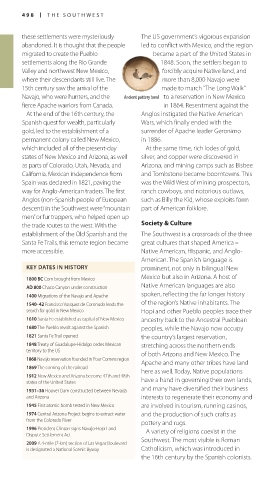
Navajo, who were hunters, and the Ancient pottery bowl to a reservation in New Mexico
fierce Apache warriors from Canada. in 1864. Resentment against the
At the end of the 16th century, the Anglos instigated the Native American
Spanish quest for wealth, particularly Wars, which finally ended with the
gold, led to the establishment of a surrender of Apache leader Geronimo
permanent colony called New Mexico, in 1886.
which included all of the present-day At the same time, rich lodes of gold,
states of New Mexico and Arizona, as well silver, and copper were discovered in
as parts of Colorado, Utah, Nevada, and Arizona, and mining camps such as Bisbee
Calif ornia. Mexican independence from and Tombstone became boomtowns. This
Spain was declared in 1821, paving the was the Wild West of mining prospectors,
way for Anglo-American traders. The first ranch cowboys, and notorious outlaws,
Anglos (non-Spanish people of European such as Billy the Kid, whose exploits form
descent) in the Southwest were “mountain part of American folklore.
men” or fur trappers, who helped open up
the trade routes to the west. With the Society & Culture
establishment of the Old Spanish and the The Southwest is a crossroads of the three
Santa Fe Trails, this remote region became great cultures that shaped America –
more accessible. Native American, Hispanic, and Anglo-
American. The Spanish language is
KEY DATES IN HISTORY prominent, not only in bilingual New
1800 BC Corn brought from Mexico Mexico but also in Arizona. A host of
AD 800 Chaco Canyon under construction Native American languages are also
1400 Migrations of the Navajo and Apache spoken, reflecting the far longer history
1540–42 Francisco Vasquez de Coronado leads the of the region’s Native inhabitants. The
search for gold in New Mexico Hopi and other Pueblo peoples trace their
1610 Santa Fe established as capital of New Mexico ancestry back to the Ancestral Puebloan
1680 The Pueblo revolt against the Spanish peoples, while the Navajo now occupy
1821 Santa Fe Trail opened the country’s largest reservation,
1848 Treaty of Guadalupe-Hidalgo cedes Mexican stretching across the northern ends
territory to the US of both Arizona and New Mexico. The
1868 Navajo reservation founded in Four Corners region Apache and many other tribes have land
1869 The coming of the railroad here as well. Today, Native populations
1912 New Mexico and Arizona become 47th and 48th
states of the United States have a hand in governing their own lands,
1931–36 Hoover Dam constructed between Nevada and many have diversified their business
and Arizona interests to regenerate their economy and
1945 First atomic bomb tested in New Mexico are involved in tourism, running casinos,
1974 Central Arizona Project begins to extract water and the production of such crafts as
from the Colorado River pottery and rugs.
1996 President Clinton signs Navajo-Hopi Land A variety of religions coexist in the
Dispute Settlement Act
2009 A 4-mile (7-km) section of Las Vegas Boulevard Southwest. The most visible is Roman
is designated a National Scenic Byway Catholicism, which was introduced in
the 16th century by the Spanish colonists.
496-499_EW_USA.indd 498 11/2/16 2:47 PM
Eyewitness Travel LAYERS PRINTED:
Portrait template “UK” LAYER
(SourceReport v1.2)
Date 5th December 2012
Size 125mm x 217mm

