


Page 547 - (DK Eyewitness) Travel Guide - USA
P. 547
NE W MEXIC O 545
Hispanic Culture in New Mexico
The heart of Hispanic culture in the Southwest is found in New Mexico. Here, the
Hispanic population, many of whom are descendants of the original Spanish colonizers
of the 16th century, outnumbers that of the Anglo-Americans. The Spanish introduced
sheep and horses to the region, as well as bringing Catholicism with its saints’ festivals
and colorful church decorations. Centuries of mixing with both the Southwest’s Native
American and Anglo cultures have also influenced every aspect of modern Hispanic
society, from language and cooking to festivals and the arts. Contemporary New
Mexican residents bear the Hispanic surnames of their ancestors, and speak English
with a Spanish accent. Even English-speakers pepper their speech with Spanish terms.
Spanish Influence
The restored El Rancho de
las Golondrinas (see p541)
is today a living museum,
centered on the hacienda,
pioneered in the Southwest
by Spanish colonists. In a
hacienda, a large number of
rooms (approximately 20)
would be set around one or
two courtyards, reflecting the
extended family style of living
favored by the Spanish.
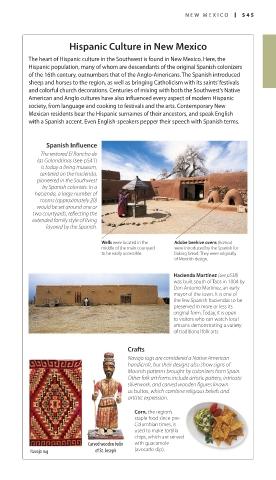
Wells were located in the Adobe beehive ovens (hornos)
middle of the main courtyard were introduced by the Spanish for
to be easily accessible. baking bread. They were originally
of Moorish design.
Hacienda Martínez (see p538)
was built south of Taos in 1804 by
Don Antonio Martínez, an early
mayor of the town. It is one of
the few Spanish haciendas to be
preserved in more or less its
original form. Today, it is open
to visitors who can watch local
artisans demonstrating a variety
of traditional folk arts.
Crafts
Navajo rugs are considered a Native American
handicraft, but their designs also show signs of
Moorish patterns brought by colonizers from Spain.
Other folk art forms include artistic pottery, intricate
silverwork, and carved wooden figures known
as bultos, which combine religious beliefs and
artistic expression.
Corn, the region’s
staple food since pre-
Columbian times, is
used to make tortilla
chips, which are served
Carved wooden bulto with guacamole
Navajo rug of St. Joseph (avocado dip).
544-545_EW_USA.indd 545 11/2/16 2:48 PM

