


Page 60 - (DK Eyewitness) Travel Guide - USA
P. 60
58 USA A T A GLANCE
The Wild West brief period, the pace of life was altered
The end of the 19th century was a time by the growth of railroads, the telegraph,
of radical change across the country. the telephone, the airplane, and the auto
The conquered South and the newly mobile. Railroads brought the once
freed slaves suffered the ravages of the distant West within reach of eastern
Reconstruction, while in the West, Native markets, and the frontier towns that
Americans saw their lands taken away appeared along the railroads were often
and their lifestyles destroyed. Their lawless places. During this
culture’s death knell was sounded postCivil War period, the
in 1862, when the Homestead Act US became an international
granted 160 acres (65 ha) of land power, buying Alaska from
to any white settler, freed slave, or Russia in 1867, then taking over
single woman. The Army battled Hawai’i in 1893, the Philippines
Native American tribes across in 1899, and Panama in 1903.
the Great Plains in the 1870s
and 1880s, and resistance in the Immigration,
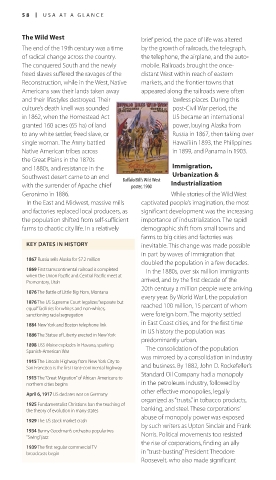
Southwest desert came to an end Buffalo Bill’s Wild West Urbanization &
with the surrender of Apache chief poster, 1900 Industrialization
Geronimo in 1886. While stories of the Wild West
In the East and Midwest, massive mills captivated people’s imagination, the most
and factories replaced local producers, as significant development was the increasing
the population shifted from selfsufficient importance of industrialization. The rapid
farms to chaotic city life. In a relatively demographic shift from small towns and
farms to big cities and factories was
KEY DATES IN HISTORY inevitable. This change was made possible
in part by waves of immigration that
1867 Russia sells Alaska for $7.2 million
doubled the population in a few decades.
1869 First transcontinental railroad is completed In the 1880s, over six million immigrants
when the Union Pacific and Central Pacific meet at
Promontory, Utah arrived, and by the first decade of the
20th century a million people were arriving
1876 The Battle of Little Big Horn, Montana
every year. By World War I, the population
1876 The US Supreme Court legalizes “separate but
equal” facilities for whites and nonwhites, reached 100 million, 15 percent of whom
sanctioning racial segregation were foreign born. The majority settled
in East Coast cities, and for the first time
1884 New York and Boston telephone link
in US history the population was
1886 The Statue of Liberty erected in New York
predominantly urban.
1898 USS Maine explodes in Havana, sparking
SpanishAmerican War The consolidation of the population
was mirrored by a consolidation in industry
1915 The Lincoln Highway from New York City to
San Francisco is the first transcontinental highway and business. By 1882, John D. Rockefeller’s
Standard Oil Company had a monopoly
1915 The “Great Migration” of AfricanAmericans to
northern cities begins in the petroleum industry, followed by
other effective monopolies, legally
April 6, 1917 US declares war on Germany
organized as “trusts,” in tobacco products,
1925 Fundamentalist Christians ban the teaching of
the theory of evolution in many states banking, and steel. These corporations’
abuse of monopoly power was exposed
1929 The US stock market crash
by such writers as Upton Sinclair and Frank
1934 Benny Goodman’s orchestra popularizes
“Swing” jazz Norris. Political movements too resisted
the rise of corporations, finding an ally
1939 The first regular commercial TV
broadcasts begin in “trustbusting” President Theodore
Roosevelt, who also made significant
052-063_EW_USA.indd 58 11/3/16 10:58 AM

