


Page 73 - (DK Eyewitness) Travel Guide - USA
P. 73
INTRODUCING NE W Y ORK CIT Y & THE MID-A TLANTIC REGION 71
military occupied New York and century, and it was this industrial might
Philadelphia and held them until the that enabled the North to withstand the
end of the Revolutionary War in 1783. divisive Civil War. The region sent more
Perhaps the most significant early battle than 600,000 men to fight for the Union,
took place in the summer of 1777 at but the main battle fought here was in
Saratoga Springs, where patriots defeated July 1863, at the small town of
the English under General John Burgoyne. Gettysburg in southeastern
Although this success Pennsylvania. Known as the
earned the Americans the “high tide” of the war, this
vital support of France, battle was the northern limit of
the revolu tionary forces, Confederate success, the only
organized into the time southern forces crossed
Continental Army under the MasonDixon Line, the
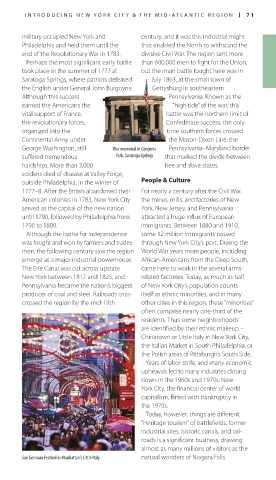
George Washington, still War memorial in Congress Pennsylvania–Maryland border
suffered tremendous Park, Saratoga Springs that marked the divide between
hardships. More than 3,000 free and slave states.
soldiers died of disease at Valley Forge,
outside Philadelphia, in the winter of People & Culture
1777–8. After the British abandoned their For nearly a century after the Civil War,
American colonies in 1783, New York City the mines, mills, and factories of New
served as the capital of the new nation York, New Jersey, and Pennsylvania
until 1790, followed by Philadelphia from attracted a huge influx of European
1790 to 1800. immigrants. Between 1880 and 1910,
Although the battle for independence some 12 million immigrants passed
was fought and won by farmers and trades through New York City’s port. During the
men, the following century saw the region World War years more people, including
emerge as a major industrial powerhouse. AfricanAmericans from the Deep South,
The Erie Canal was cut across upstate came here to work in the several arms
New York between 1817 and 1825, and related factories. Today, as much as half
Pennsylvania became the nation’s biggest of New York City’s population counts
producer of coal and steel. Railroads criss itself as ethnic minorities, and in many
crossed the region by the mid19th other cities in this region, these “minorities”
often comprise nearly onethird of the
residents. Thus some neighborhoods
are identified by their ethnic makeup –
Chinatown or Little Italy in New York City,
the Italian Market in South Philadelphia, or
the Polish areas of Pittsburgh’s South Side.
Years of labor strife, and many economic
upheavals led to many industries closing
down in the 1960s and 1970s. New
York City, the financial center of world
capitalism, flirted with bankruptcy in
the 1970s.
Today, however, things are different.
“Heritage tourism” of battlefields, former
industrial sites, historic canals, and rail
roads is a significant business, drawing
almost as many millions of visitors as the
San Gennaro Festival in Manhattan’s Little Italy natural wonders of Niagara Falls.
068-071_EW_USA.indd 71 11/2/16 2:43 PM

