


Page 58 - All About History - Issue 38-16
P. 58
The Weird World of Airships
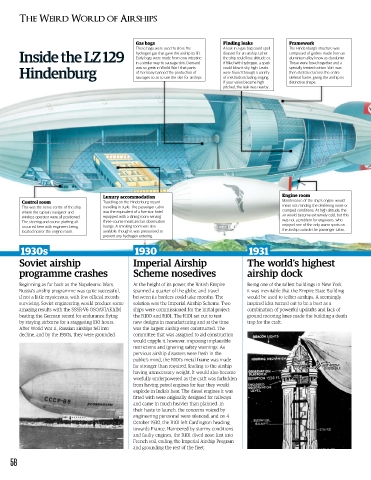
Gas bags Finding leaks Framework
These bags were used to store the
A leak in a gas bag could spell
The Hindenburg’s structure was
Inside the LZ 129 hydrogen gas that gave the airship its lift. disaster for an airship. Either composed of girders made from an
the ship could lose altitude or,
Early bags were made from cow intestine
aluminium alloy know as duralumin.
These were fused together and a
if filled with hydrogen, a spark
in a similar way to sausage skin. Demand
Hindenburg was so great in World War I that parts could blow it sky high. Leaks specially treated cotton ‘skin’ was
then stretched across the entire
were found through a variety
of Germany banned the production of
sausages so as to use the skin for airships.
of methods including singing.
distinctive shape.
If your voice became high skeletal frame, giving the airship its
pitched, the leak was nearby.
Luxury accommodation Engine room
Control room Travelling on the Hindenburg meant Maintenance of the ship’s engine would
This was the nerve centre of the ship travelling in style. The passenger cabin mean not minding the deafening noise or
where the captain, navigator and was the equivalent of a five-star hotel cramped conditions. At high altitude, the
wireless operator were all positioned. equipped with a dining room serving air would become extremely cold, but this
The steering and course plotting all three-course meals and an observation was not a problem for engineers, who
occurred here with engineers being lounge. A smoking room was also enjoyed one of the only warm spots on
located nearer the engine room. available, though it was pressurised to the airship outside the passenger cabin.
prevent any hydrogen entering.
1930s 1930 1931
Soviet airship Imperial Airship The world’s highest
programme crashes Scheme nosedives airship dock
Beginning as far back as the Napoleonic Wars, At the height of its power, the British Empire Being one of the tallest buildings in New York,
Russia’s airship programme was quite successful, spanned a quarter of the globe, and travel it was inevitable that the Empire State Building
if not a little mysterious, with few official records between its borders could take months. The would be used to tether airships. A seemingly
surviving. Soviet engineering would produce some solution was the Imperial Airship Scheme. Two inspired idea turned out to be a bust as a
amazing results with the SSSRV6 OSOAVIAKhIM ships were commissioned for the initial project: combination of powerful updrafts and lack of
beating the German record for endurance flying the R100 and R101. The R101 set out to test ground mooring lines made the building a death
by staying airborne for a staggering 130 hours. new designs in manufacturing and at the time trap for the craft.
After World War II, Russian airships fell into was the largest airship ever constructed. The
decline, and by the 1950s, they were grounded. committee that was assigned to aid construction
would cripple it, however, imposing implausible
restrictions and ignoring safety warnings. As
pervious airship disasters were fresh in the
public’s mind, the R101’s metal frame was made
far stronger than required, leading to the airship
having unnecessary weight. It would also become
woefully underpowered as the craft was forbidden
from having petrol engines for fear they would
explode in India’s heat. The diesel engines it was
fitted with were originally designed for railways
and came in much heavier than planned. In
their haste to launch, the concerns voiced by
engineering personnel were silenced, and on 4
October 1930, the R101 left Cardington heading
towards France. Hampered by stormy conditions
and faulty engines, the R101 dived nose first into
French soil, ending the Imperial Airship Program
and grounding the rest of the fleet.
58
054-059_AAH38_Airships.indd 58 13/04/2016 22:22

