


Page 334 - (DK) The Ultimate Visual Dictionary 2nd Ed.
P. 334
RAIL AND ROAD

       Trolleys and buses


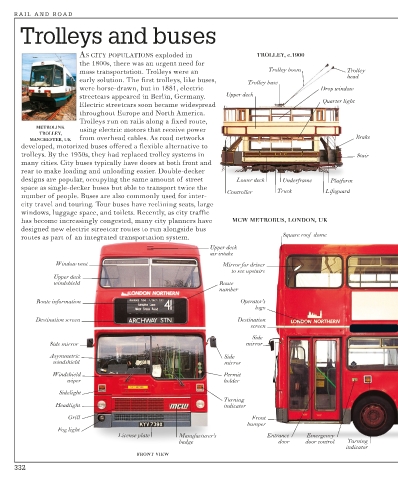
                       AS CITY POPULATIONS exploded in                  TROLLEY, c.1900
                       the 1800s, there was an urgent need for
                       mass transportation. Trolleys were an                Trolley boom         Trolley
                                                                                                 head
                       early solution. The first trolleys, like buses,   Trolley base
                       were horse-drawn, but in 1881, electric                            Drop window
                       streetcars appeared in Berlin, Germany.   Upper deck
                                                                                           Quarter light
                       Electric streetcars soon became widespread
                       throughout Europe and North America.
                       Trolleys run on rails along a fixed route,
           METROLINK   using electric motors that receive power
            TROLLEY,
         MANCHESTER, UK  from overhead cables. As road networks                                     Brake
       developed, motorized buses offered a flexible alternative to
       trolleys. By the 1930s, they had replaced trolley systems in                                 Stair
       many cities. City buses typically have doors at both front and
       rear to make loading and unloading easier. Double-decker
       designs are popular, occupying the same amount of street    Lower deck  Underframe    Platform
       space as single-decker buses but able to transport twice the
                                                                Controller    Truck        Lifeguard
       number of people. Buses are also commonly used for inter-
       city travel and touring. Tour buses have reclining seats, large
       windows, luggage space, and toilets. Recently, as city traffic
       has become increasingly congested, many city planners have   MCW METROBUS, LONDON, UK
       designed new electric streetcar routes to run alongside bus
                                                                                Square roof  dome
       routes as part of an integrated transportation system.
                                                           Upper deck
                                                           air intake
                 Window vent                                   Mirror for driver
                                                                 to see upstairs
                Upper deck
                windshield                                    Route
                                                              number
           Route information                                        Operator’s
                                                                        logo
           Destination screen                                      Destination
                                                                       screen
                                                                       Side
                 Side mirror                                         mirror
               Asymmetric                                      Side
                windshield                                     mirror
                Windshield                                     Permit
                    wiper                                      holder
                 Sidelight
                                                               Turning
                Headlight                                      indicator
                    Grill                                              Front
                                                                      bumper
                 Fog light
                                  License plate    Manufacturer’s          Entrance   Emergency
                                                   badge                      door    door control  Turning
                                                                                                 indicator
                                       FRONT VIEW

     332

