


Page 394 - (DK) The Ultimate Visual Dictionary 2nd Ed.
P. 394
SEA AND AIR

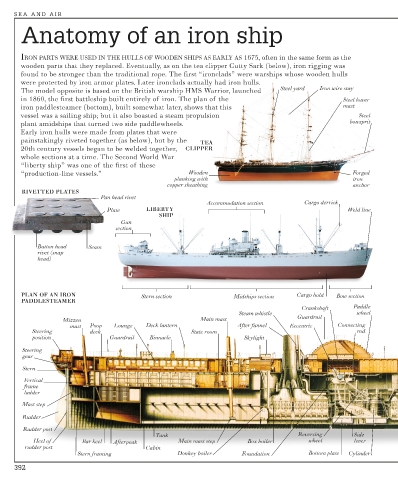
       Anatomy of an iron ship


       IRON PARTS WERE USED IN THE HULLS OF WOODEN SHIPS AS EARLY AS 1675, often in the same form as the
       wooden parts that they replaced. Eventually, as on the tea clipper Cutty Sark (below), iron rigging was
       found to be stronger than the traditional rope. The first “ironclads” were warships whose wooden hulls
       were protected by iron armor plates. Later ironclads actually had iron hulls.
       The model opposite is based on the British warship HMS Warrior, launched   Steel yard  Iron wire stay
       in 1860, the first battleship built entirely of iron. The plan of the                    Steel lower
       iron paddlesteamer (bottom), built somewhat later, shows that this                       mast
       vessel was a sailing ship; but it also boasted a steam propulsion                             Steel
       plant amidships that turned two side paddlewheels.                                         bowsprit
       Early iron hulls were made from plates that were
       painstakingly riveted together (as below), but by the   TEA
       20th century vessels began to be welded together,   CLIPPER
       whole sections at a time. The Second World War
       “liberty ship” was one of the first of these
       “production-line vessels.”                    Wooden                                        Forged
                                                 planking with                                     iron
                                               copper sheathing                                    anchor
       RIVETTED PLATES
                             Pan head rivet
                                                          Accommodation section       Cargo derrick
                               Plate      LIBERTY                                                 Weld line
                                             SHIP
                                   Gun
                                 section

           Button head    Seam
           rivet (snap
           head)


       PLAN OF AN IRON                  Stern section             Midships section  Cargo hold  Bow section
       PADDLESTEAMER
                                                                                     Crankshaft    Paddle
                                                                   Steam whistle                    wheel
                  Mizzen                                 Main mast                  Guardrail
                    mast  Poop   Lounge   Deck lantern             After funnel  Eccentric     Connecting
          Steering        deck                        State room                                    rod
          position             Guardrail   Binnacle                  Skylight
       Steering
       gear

       Stern
        Vertical
        frame
        ladder
       Mast step
       Rudder
       Rudder post
                                            Tank                                    Reversing      Side
          Heel of       Bar keel  Afterpeak       Main mast step      Box boiler       wheel       lever
        rudder post                      Cabin
                       Stern framing              Donkey boiler     Foundation         Bottom plate  Cylinder

     392

