


Page 480 - (DK) The Ultimate Visual Dictionary 2nd Ed.
P. 480
ARCHITECTURE
                                                                                   DETAILS FROM ITALIAN
       Baroque and                                                                  BAROQUE CHURCHES


       neoclassical 1


       THE BAROQUE STYLE EVOLVED IN THE EARLY 17TH CENTURY in Rome. It is characterized
       by curved outlines and ostentatious decoration, as can be seen in the Italian church
       details (right). The baroque style was particularly widely favored in Italy, Spain,
       and Germany. It was also adopted in Britain and France, but with adaptations. The
       British architects Sir Christopher Wren and Nicholas Hawksmoor, for example,
       used baroque features—such as the concave walls of St. Paul’s Cathedral and the   SCROLLED BUTTRESS,
       curved buttresses of the Church of St. George in the East (see pp. 480-481)—but   CHURCH OF ST. MARIA DELLA
       they did so with restraint. Similarly, the curved buttresses and volutes of the   SALUTE, VENICE, 1631-1682
       Parisian Church of St. Paul-St. Louis are relatively plain. In the second half of
       the 17th century, a distinct classical style (known as neoclassicism) developed in
       northern Europe as a reaction to the excesses of baroque. Typical of this new style
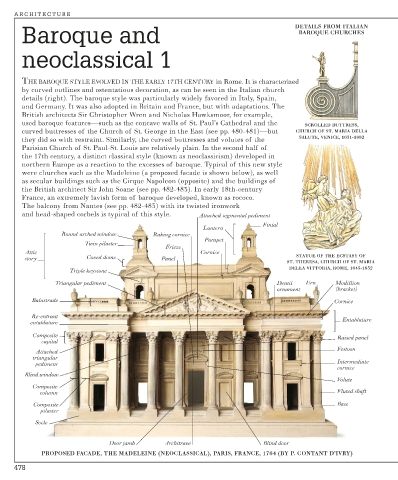
       were churches such as the Madeleine (a proposed facade is shown below), as well
       as secular buildings such as the Cirque Napoleon (opposite) and the buildings of
       the British architect Sir John Soane (see pp. 482-483). In early 18th-century
       France, an extremely lavish form of baroque developed, known as rococo.
       The balcony from Nantes (see pp. 482-483) with its twisted ironwork
       and head-shaped corbels is typical of this style.  Attached segmental pediment
                                                                          Finial
                                                         Lantern
                  Round-arched window       Raking cornice
                                                          Parapet
                         Twin pilaster
                                               Frieze
        Attic                                            Cornice
        story            Coved dome           Panel                                STATUE OF THE ECSTASY OF
                                                                                 ST. THERESA, CHURCH OF ST. MARIA
                                                                                 DELLA VITTORIA, ROME, 1645-1652
                    Triple keystone
                Triangular pediment                                           Dentil   Urn    Modillion
                                                                              ornament        (bracket)
          Balustrade                                                                          Cornice
          Re-entrant
         entablature                                                                            Entablature
          Composite                                                                            Raised panel
             capital
                                                                                               Festoon
           Attached
          triangular
           pediment                                                                            Intermediate
                                                                                               cornice
        Blind window
                                                                                               Volute
          Composite
            column                                                                             Fluted shaft
          Composite                                                                            Base
            pilaster
           Socle

                               Door jamb       Architrave                 Blind door
             PROPOSED FACADE, THE MADELEINE (NEOCLASSICAL), PARIS, FRANCE, 1764 (BY P. CONTANT D’IVRY)

     478

