


Page 504 - (DK) The Ultimate Visual Dictionary 2nd Ed.
P. 504
MUSIC

       Musical notation                                           THE PRODIGAL SON, ARTHUR SULLIVAN, 1869
                                                                    EXAMPLE OF AN ORIGINAL MANUSCRIPT:

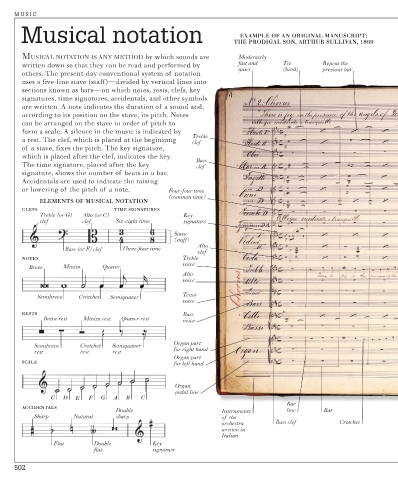
       MUSICAL NOTATION IS ANY METHOD by which sounds are          Moderately
       written down so that they can be read and performed by      fast and     Tie        Repeat the
                                                                   quiet        (bind)     previous bar
       others. The present-day conventional system of notation
       uses a five-line stave (staff)—divided by vertical lines into
       sections known as bars—on which notes, rests, clefs, key
       signatures, time signatures, accidentals, and other symbols
       are written. A note indicates the duration of a sound and,
       according to its position on the stave, its pitch. Notes
       can be arranged on the stave in order of pitch to
       form a scale. A silence in the music is indicated by
                                                      Treble
       a rest. The clef, which is placed at the begininng   clef
       of a stave, fixes the pitch. The key signature,
       which is placed after the clef, indicates the key.
                                                        Bass
       The time signature, placed after the key         clef
       signature, shows the number of beats in a bar.
       Accidentals are used to indicate the raising
       or lowering of the pitch of a note.      Four-four time
                                                (common time)
            ELEMENTS OF MUSICAL NOTATION
       CLEFS                     TIME SIGNATURES
            Treble (or G)   Alto (or C)             Key
            clef        clef     Six-eight time     signature
                                                 Stave
                                                 (staff)
                                                        Alto
                   Bass (or F) clef  Three-four time
                                                        clef
       NOTES                                        Treble
                                                    voice
         Breve     Minim     Quaver
                                                    Alto
                                                    voice
                                                    Tenor
           Semibreve   Crotchet  Semiquaver
                                                    voice
       RESTS                                        Bass
             Breve rest  Minim rest  Quaver rest    voice


                                                 Organ part
           Semibreve   Crotchet   Semiquaver
           rest        rest     rest             for right hand
                                                 Organ part
       SCALE                                     for left hand

                                                  Organ
                                                  pedal line
               C  D   E   F  G  A   B   C
                                                                                 Bar
       ACCIDENTALS
                                 Double                        Instruments       line      Bar
           Sharp     Natural     sharp                         of  the
                                                               orchestra      Bass clef        Crotchet
                                                               written in
                                                               Italian
                Flat       Double          Key
                           flat            signature

     502

