


Page 586 - (DK) The Ultimate Visual Dictionary 2nd Ed.
P. 586
THE MODERN WORLD
       Home cinema


                                                                              BLU-RAY PLAYER
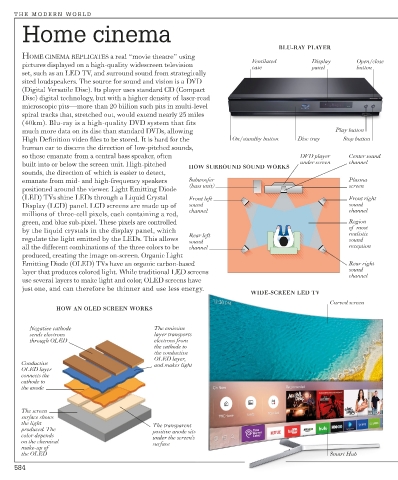
       HOME CINEMA REPLICATES a real “movie theatre” using
                                                                       Ventilated       Display     Open/close
       pictures displayed on a high-quality widescreen television
                                                                       case             panel       button
       set, such as an LED TV, and surround sound from strategically
       sited loudspeakers. The source for sound and vision is a DVD
       (Digital Versatile Disc). Its player uses standard CD (Compact
       Disc) digital technology, but with a higher density of laser-read
       microscopic pits—more than 20 billion such pits in multi-level
       spiral tracks that, stretched out, would extend nearly 25 miles
       (40km). Blu-ray is a high-quality DVD system that fits
       much more data on its disc than standard DVDs, allowing                                Play button
       High Definition video files to be stored. It is hard for the    On/standby button  Disc tray  Stop button
       human ear to discern the direction of low-pitched sounds,
       so these emanate from a central bass speaker, often                          DVD player    Center sound
       built into or below the screen unit. High-pitched                            under screen  channel
                                                     HOW SURROUND SOUND WORKS
       sounds, the direction of which is easier to detect,
       emanate from mid- and high-frequency speakers   Subwoofer                                  Plasma
                                                     (bass unit)                                  screen
       positioned around the viewer. Light Emitting Diode
       (LED) TVs shine LEDs through a Liquid Crystal   Front left                                 Front right
       Display (LCD) panel. LCD screens are made up of   sound                                    sound
                                                     channel                                      channel
       millions of three-cell pixels, each containing a red,
       green, and blue sub-pixel. These pixels are controlled                                     Region
                                                                                                  of  most
       by the liquid crystals in the display panel, which
                                                     Rear left                                    realistic
       regulate the light emitted by the LEDs. This allows                                        sound
                                                     sound
       all the different combinations of the three colors to be   channel                         reception
       produced, creating the image on-screen. Organic Light
       Emitting Diode (OLED) TVs have an organic carbon-based                                     Rear right
                                                                                                  sound
       layer that produces colored light. While traditional LED screens
                                                                                                  channel
       use several layers to make light and color, OLED screens have
       just one, and can therefore be thinner and use less energy.
                                                                       WIDE-SCREEN LED TV
                                                                                             Curved screen
                 HOW AN OLED SCREEN WORKS

         Negative cathode                   The emissive
         sends electrons                    layer transports
         through OLED                       electrons from
                                            the cathode to
                                            the conductive
                                            OLED layer,
       Conductive                           and makes light
       OLED layer
       connects the
       cathode to
       the anode


       The screen
       surface shows
       the light                           The transparent
       produced. The                       positive anode sits
       color depends                       under the screen’s
       on the chemical                     surface
       make-up of
       the OLED                                                                              Smart Hub

     584

