


Page 78 - (DK) The Ultimate Visual Dictionary 2nd Ed.
P. 78
PREHISTORIC EAR TH

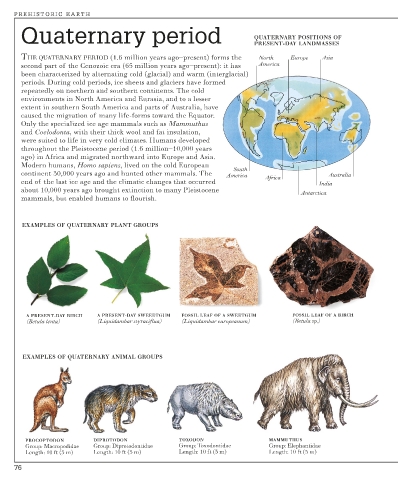
       Quaternary period                                                QUATERNARY POSITIONS OF
                                                                        PRESENT-DAY LANDMASSES

       THE QUATERNARY PERIOD (1.6 million years ago–present) forms the   North    Europe  Asia
       second part of the Cenozoic era (65 million years ago–present): it has   America
       been characterized by alternating cold (glacial) and warm (interglacial)
       periods. During cold periods, ice sheets and glaciers have formed
       repeatedly on northern and southern continents. The cold
       environments in North America and Eurasia, and to a lesser
       extent in southern South America and parts of Australia, have
       caused the migration of many life-forms toward the Equator.
       Only the specialized ice age mammals such as Mammuthus
       and Coelodonta, with their thick wool and fat insulation,
       were suited to life in very cold climates. Humans developed
       throughout the Pleistocene period (1.6 million–10,000 years
       ago) in Africa and migrated northward into Europe and Asia.
       Modern humans, Homo sapiens, lived on the cold European
                                                                  South
       continent 30,000 years ago and hunted other mammals. The   America  Africa           Australia
       end of the last ice age and the climatic changes that occurred                     India
       about 10,000 years ago brought extinction to many Pleistocene
                                                                                     Antarctica
       mammals, but enabled humans to flourish.


       EXAMPLES OF QUATERNARY PLANT GROUPS


        A PRESENT-DAY BIRCH  A PRESENT-DAY SWEEETGUM  FOSSIL LEAF OF A SWEETGUM   FOSSIL LEAF OF A BIRCH
        (Betula lenta)      (Liquidambar styraciflua)  (Liquidambar europeanum)   (Betula sp.)


       EXAMPLES OF QUATERNARY ANIMAL GROUPS


        PROCOPTODON        DIPROTODON              TOXODON                  MAMMUTHUS
        Group: Macropodidae   Group: Diprotodontidae   Group: Toxodontidae   Group: Elephantidae
        Length: 10 ft (3 m)  Length: 10 ft (3 m)   Length: 10 ft (3 m)      Length: 10 ft (3 m)

     76

