


Page 70 - Simply Crochet - Issue 93 2020
P. 70
F  g                        j                              crochet                                       a  A


                                                            Unravelled
                                                            Unravelled


                                                                                With
                                                                          Becky Skuse


                 What’s the proper way to hold my hook?


                                          Brush up on your technique with our hook-apedia…


          Whether you’re brand new to crochet or you’ve been crocheting for      pencil grip and the knife grip. We’ll show you how each one works,
          decades, it all starts with a hook. But are you holding your hook in the  and the pros and cons, so you can try both and see what suits. It’s
          best way to achieve top crochet results, as well as avoiding aches,    really important to feel comfortable holding the hook, as holding it
          pains and strains? There’s no such thing as ‘one size fits all’ in crochet   in the wrong way for you can cause pain in your hand and wrist. So,
          and every crocheter seems to hold the hook and yarn slightly           even if you’re a seasoned hookster, treat yourself to a bit of time to
          differently! There tends to be two general methods though: the         refresh your grip and see if you enjoy quicker and easier crocheting.


                                                 What’s the best sort of hook?


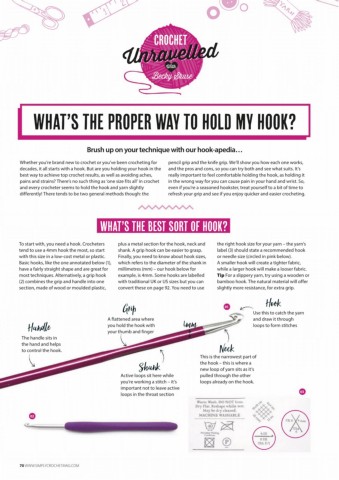
          To start with, you need a hook. Crocheters     plus a metal section for the hook, neck and     the right hook size for your yarn – the yarn’s
          tend to use a 4mm hook the most, so start      shank. A grip hook can be easier to grasp.      label (3) should state a recommended hook
          with this size in a low-cost metal or plastic.  Finally, you need to know about hook sizes,    or needle size (circled in pink below).
          Basic hooks, like the one annotated below (1),  which refers to the diameter of the shank in   A smaller hook will create a tighter fabric,
          have a fairly straight shape and are great for  millimetres (mm) – our hook below for          while a larger hook will make a looser fabric.
          most techniques. Alternatively, a grip hook    example, is 4mm. Some hooks are labelled        Tip For a slippery yarn, try using a wooden or
          (2) combines the grip and handle into one      with traditional UK or US sizes but you can     bamboo hook. The natural material will offer
          section, made of wood or moulded plastic,      convert these on page 92. You need to use       slightly more resistance, for extra grip.


                                                                                                                                5ïX
                                                            Grip                                             01

                                                                                                                          Use this to catch the yarn
                                                    A flattened area where                                                and draw it through
              Handle                                you hold the hook with               4mm                              loops to form stitches
                                                    your thumb and finger
           The handle sits in
           the hand and helps
           to control the hook.                                                                           ;RPX
                                                                                                 This is the narrowest part of
                                                                   @UN[X                         the hook – this is where a
                                                                                                 new loop of yarn sits as it’s
                                                           Active loops sit here while           pulled through the other
                                                           you’re working a stitch – it’s        loops already on the hook.
                                                           important not to leave active
                                                                                                                                                 03
                                                           loops in the throat section


               02


          70 WWW.SIMPLYCROCHETMAG.COM

