


Page 45 - History of War - Issue 29-16
P. 45
SEDAN
“UNABLE TO BREAK THE PRUSSIAN LINE, THE NORTHEASTERN FRANCE
DEJECTED SURVIVORS RETURNED TO THEIR 1 SEPTEMBER 1870
LINES. THE CHASSEURS’ CHARGE WAS THE LAST
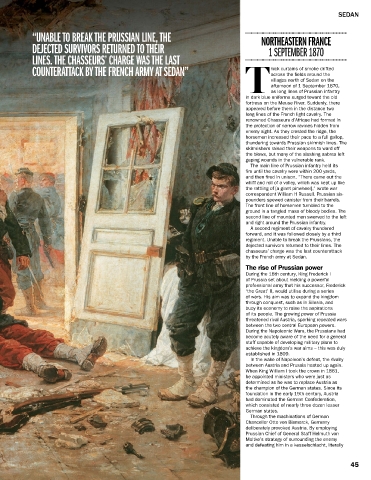
COUNTERATTACK BY THE FRENCH ARMY AT SEDAN” hick curtains of smoke drifted
across the elds around the
villages north of Sedan on the
afternoon of 1 September 1870,
T as long lines of Prussian infantry
in dark blue uniforms surged toward the old
fortress on the Meuse River. Suddenly, there
appeared before them in the distance two
long lines of the French light cavalry. The
renowned Chasseurs d’Afrique had formed in
the protection of narrow ravines hidden from
enemy sight. As they crested the ridge, the
horsemen increased their pace to a full gallop,
thundering towards Prussian skirmish lines. The
skirmishers raised their weapons to ward off
the blows, but many of the slashing sabres left
gaping wounds in the vulnerable rank.
The main line of Prussian infantry held its
re until the cavalry were within 200 yards,
and then red in unison. “There came out the
whiff and roll of a volley, which was kept up like
the rattling of [a giant pinwheel],” wrote war
correspondent William H Russell. Prussian six-
pounders spewed canister from their barrels.
The front line of horsemen tumbled to the
ground in a tangled mass of bloody bodies. The
second line of mounted men swerved to the left
and right around the Prussian infantry.
A second regiment of cavalry thundered
forward, and it was followed closely by a third
regiment. Unable to break the Prussians, the
dejected survivors returned to their lines. The
chasseurs’ charge was the last counterattack
by the French army at Sedan.
The rise of Prussian power
During the 18th century, King Frederick I
of Prussia set about melding a powerful
professional army that his successor, Frederick
‘the Great’ II, would utilise during a series
of wars. His aim was to expand the kingdom
through conquest, such as in Silesia, and
buoy its economy to raise the aspirations
of its people. The growing power of Prussia
threatened rival Austria, sparking repeated wars
between the two central European powers.
During the Napoleonic Wars, the Prussians had
become acutely aware of the need for a general
staff capable of developing military plans to
achieve the kingdom’s war aims – this was duly
established in 1809.
In the wake of Napoleon’s defeat, the rivalry
between Austria and Prussia heated up again.
When King William I took the crown in 1861,
he appointed ministers who were just as
determined as he was to replace Austria as
the champion of the German states. Since its
foundation in the early 19th century, Austria
had dominated the German Confederation,
which consisted of nearly three dozen lesser
German states.
Through the machinations of German
Chancellor Otto von Bismarck, Germany
deliberately provoked Austria. By employing
Prussian Chief of General Staff Helmuth von
Moltke’s strategy of surrounding the enemy
and defeating him in a kesselschlacht, literally
45
044-051_Great_Battles_Sedan.indd 45 04/05/2016 19:13

