


Page 138 - (DK Eyewitness) Travel Guide - Austria
P. 138
136 A USTRIA REGION B Y REGION
1 St Pölten friary, occupies the narrow,
northern end of the
The capital of Lower Austria since 1986, St Pölten was Rathausplatz. A Rococo church
the first Austrian city to be granted municipal rights, in with a delightful pink façade,
1159. Its history dates back to Roman times, and it achieved it is unusual because it has
considerable status under the Augustinian orders in the 8th no tower. The church interior,
century. St Pölten’s fastest period of growth, however, was also decorated in Rococo
style, features an altarpiece by
during the Baroque period, when outstanding masters of that Andreas Gruber. There are four
era, such as the architect Jakob Prandtauer and the painters wing paintings by another well
Daniel Gran, Paul Troger and Bartolomeo Altomonte, made known Austrian Baroque artist,
their home here. Economically, St Pölten became the most Martin Johann Schmidt, known
important city in Lower Austria when trade switched from the as Kremser Schmidt.
Danube waterways to overland roads.
P Rathaus
Rathausplatz 1.
Tel (02742) 333 3000.
The present town hall was
built in the 16th century by
combining two Gothic
buildings in a mishmash of
incongruous styles. The niches
of the Gothic entrance gate
abut a Renaissance portal, the
Gothic tower has a Baroque
onion dome on top, and the
entire structure has been
concealed behind a Baroque
façade. Inside, however, it is
worth seeing the ceiling
stuccowork in the Mayor’s
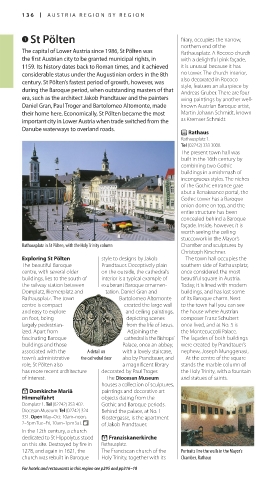
Rathausplatz in St Pölten, with the Holy Trinity column Chamber and sculptures by
Christoph Kirschner.
Exploring St Pölten style to designs by Jakob The town hall occupies the
The beautiful Baroque Prandtauer. Deceptively plain southern side of Rathausplatz,
centre, with several older on the outside, the cathe dral’s once considered the most
buildings, lies to the south of interior is a typical example of beautiful square in Austria.
the railway station between exuberant Baroque ornamen Today, it is lined with modern
Domplatz, Riemerplatz and tation. Daniel Gran and buildings, and has lost some
Rathausplatz. The town Bartolomeo Altomonte of its Baroque charm. Next
centre is compact created the large wall to the town hall you can see
and easy to explore and ceiling paintings, the house where Austrian
on foot, being depicting scenes composer Franz Schubert
largely pedestrian from the life of Jesus. once lived, and at No. 5 is
ized. Apart from Adjoining the the Montecuccoli Palace.
fascinating Baroque cathe dral is the Bishops’ The façades of both buildings
buildings and those Palace, once an abbey, were created by Prandtauer’s
associated with the A detail on with a lovely staircase, nephew, Joseph Munggenast.
town’s administrative the cathedral door also by Prandtauer, and At the centre of the square
role, St Pölten also a magnificent library stands the marble column of
has more recent architecture decorated by Paul Troger. the Holy Trinity, with a fountain
of interest. The Diocesan Museum and statues of saints.
houses a collection of sculptures,
R Domkirche Mariä paint ings and decorative art
Himmelfahrt objects dating from the
Domplatz 1. Tel (02742) 353 402. Gothic and Baroque periods.
Diocesan Museum: Tel (02742) 324 Behind the palace, at No. 1
331. Open May–Oct: 10am–noon, Klostergasse, is the apartment
2–5pm Tue–Fri, 10am–1pm Sat. 8 of Jakob Prandtauer.
In the 12th century, a church
dedicated to St Hippolytus stood R Franziskanerkirche
on this site. Destroyed by fire in Rathausplatz.
1278, and again in 1621, the The Franciscan church of the Portraits line the walls in the Mayor’s
church was rebuilt in Baroque Holy Trinity, together with its Chamber, Rathaus
For hotels and restaurants in this region see p295 and pp316–18
136-137_EW_Austria.indd 136 12/09/17 2:45 pm

