


Page 189 - (DK Eyewitness) Travel Guide - Austria
P. 189
ST Y RIA 187
k Leoben
Tips for Drivers Road map F4. * 25,000. £ @
n Hauptplatz 3, (03842) 48148-0.
Length of route: 100 km
(60 miles). Leoben, Styria’s second largest
Stopping places: the only town, is an industrial and
overnight accommodation is academic centre. Beautiful
available at Weichselboden. mansion houses line the
Suggestions: the hike to the top Hauptplatz (the main square),
of Hochschwab is challenging, and the adjacent streets bear
taking 7–8 hours, but is worth it witness to the town’s early
for the stunning views
wealth derived from the local
iron deposits. There is a lovely
old town hall with coats of
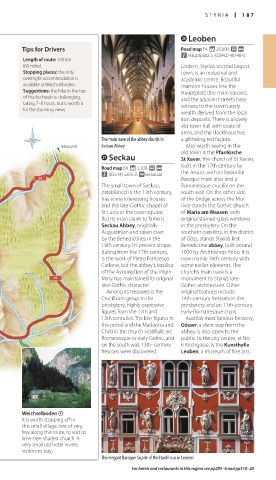
arms, and the Hacklhaus has
The main nave of the abbey church in a glittering red façade.
Mariazell Seckau Abbey Also worth seeing in the
old town is the Pfarrkirche
j Seckau St Xaver, the church of St Xavier,
built in the 17th century by
Road map E4. * 1,300. £ @
n (03514) 5205-3. ∑seckau.at the Jesuits, with its beautiful
Baroque main altar and a
The small town of Seckau, Romanesque crucifix on the
established in the 13th century, south wall. On the other side
has some interesting houses of the bridge across the Mur
and the late-Gothic chapel of river stands the Gothic church
St Lucia in the town square. of Maria am Waasen, with
But its main claim to fame is original stained-glass windows
Seckau Abbey, originally in the presbytery. On the
Augustinian and taken over southern outskirts, in the district
by the Benedictines in the of Göss, stands Styria’s first
19th century. Its present shape, Benedictine abbey, built around
dating from the 17th century, 1000 by Archbishop Aribo. It is
is the work of Pietro Francesco now mainly 16th-century with
Carlone, but the abbey’s basilica some earlier elements. The
of the Assumption of the Virgin church’s main nave is a
Mary has maintained its original monument to Styria’s late-
late-Gothic character. Gothic architecture. Other
Among its treasures is the original features include
Crucifixion group in the 14th-century frescoes in the
presbytery, highly expressive presbytery and an 11th-century,
figures from the 12th and early-Romanesque crypt.
13th centuries. The lion figures in Austria’s most famous brewery,
the portal and the Madonna and Gösser, a short way from the
Child in the church vestibule are abbey, is also open to the
Romanesque or early Gothic, and public. In the city centre, at No.
on the south wall, 13th- century 6 Kirchgasse, is the Kunsthalle
frescoes were discovered. Leoben, a museum of fine arts.
Weichselboden 4
It is worth stopping off in
this small village, one of very
few along this route, to visit its
lime-tree-shaded church. A
very small old hotel invites
visitors to stay.
The elegant Baroque façade of the Hacklhaus in Leoben
For hotels and restaurants in this region see pp295–6 and pp318–20
186-187_EW_Austria.indd 187 12/09/17 3:04 pm

