


Page 304 - (DK Eyewitness) Travel Guide - Austria
P. 304
302 TR A VELLERS ’ NEEDS
The Flavours of Austria: Savoury Dishes
Austrian cuisine is a direct legacy of the country’s imperial past,
when culinary traditions from many parts of Europe influenced
Viennese cooks. As a result, it is far more varied and flavoursome
than most people realize. There are Italian and Adriatic influences,
Polish- and Hungarian- inspired dishes, and even a rich seam of
Balkan flavours running through much of the Austrian kitchen
repertoire. Schnitzel, for example, is an import from Milan,
which was once under Austrian control, while Gulasch is the
Austrian version of the Hungarian dish that became popular in
Vienna in the 19th century. Chanterelle mushrooms
sausages. The classic Austrian Bratwurst, made with beef,
way with pork is to cure it, pork and veal, are Austria’s
smoke it and leave it to mature preferred sausages, but other
for months in the clean air types such as Frankfurters are
of the high Alpine pastures. also common. Chicken is
The result is called Speck. almost always served breaded,
Lean Speck is similar to Italian but Grillhendl is a whole
prosciutto, though with a chicken roasted over an open
distinctive smoky tang, while fire, or on a spit. Duck (Ente)
fattier cuts are more like is often served with sweet
pancetta or streaky bacon. sauces, but sometimes with
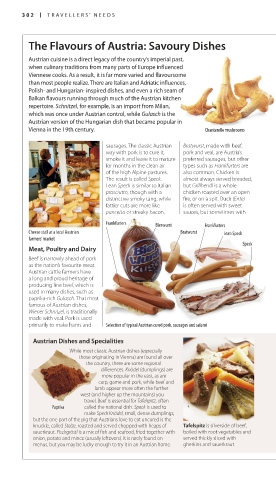
Frankfurters Bierwurst Frankfurters
Cheese stall at a local Austrian Bratwurst Lean Speck
farmers’ market
Speck
Meat, Poultry and Dairy
Beef is narrowly ahead of pork
as the nation’s favourite meat.
Austrian cattle farmers have
a long and proud heritage of
producing fine beef, which is
used in many dishes, such as
paprika-rich Gulasch. That most
famous of Austrian dishes,
Wiener Schnitzel, is traditionally
made with veal. Pork is used
primarily to make hams and Selection of typical Austrian cured pork, sausages and salami
Austrian Dishes and Specialities
While most classic Austrian dishes (especially
those originating in Vienna) are found all over
the country, there are some regional
differences. Knödel (dumplings) are
more popular in the east, as are
carp, game and pork, while beef and
lamb appear more often the further
west (and higher up the mountains) you
travel. Beef is essential for Tafelspitz, often
Paprika called the national dish. Speck is used to
make Speck Knödel, small, dense dumplings,
but the one part of the pig that Austrians love to eat uncured is the
knuckle, called Stelze, roasted and served chopped with heaps of Tafelspitz is silverside of beef,
sauerkraut. Fischgröstl is a mix of fish and seafood, fried together with boiled with root vegetables and
onion, potato and mince (usually leftovers). It is rarely found on served thickly sliced with
menus, but you may be lucky enough to try it in an Austrian home. gherkins and sauerkraut.
302-303_EW_Austria.indd 302 12/09/17 3:05 pm
Eyewitness Travel LAYERS PRINTED:
Feature template “UK” LAYER
(SourceReport v1.3)
Date 7th January 2013
Size 125mm x 217mm

