


Page 351 - (DK Eyewitness) Travel Guide - Austria
P. 351
PR A C TIC AL INFORM A TION 349
The Euro euro in 2002, with the Austrian Euro notes are identical
The euro (€) is the common schilling phased out in the throughout the Eurozone
currency of the European same year. countries. The coins, however,
Union. It went into general EU members using the euro have one side identical (the
circulation on 1 January 2002, as sole official currency are value side), and one side with
initially for 12 participating known as the Eurozone. Several an image unique to each
countries. Austria was one of EU members have opted out of country, though they can be
those 12 countries taking the joining this common currency. used throughout the Eurozone.
Banknotes
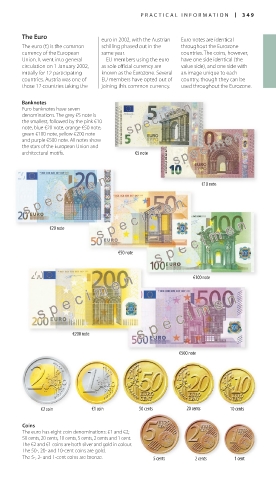
Euro banknotes have seven
denominations. The grey €5 note is
the smallest, followed by the pink €10
note, blue €20 note, orange €50 note,
green €100 note, yellow €200 note
and purple €500 note. All notes show
the stars of the European Union and
architectural motifs. €5 note
€10 note
€20 note
€50 note
€100 note
€200 note
€500 note
€2 coin €1 coin 50 cents 20 cents 10 cents
Coins
The euro has eight coin denominations: €1 and €2;
50 cents, 20 cents, 10 cents, 5 cents, 2 cents and 1 cent.
The €2 and €1 coins are both silver and gold in colour.
The 50-, 20- and 10-cent coins are gold.
The 5-, 2- and 1-cent coins are bronze. 5 cents 2 cents 1 cent
348-349_EW_Austria.indd 349 12/09/17 3:05 pm

