


Page 9 - (DK Eyewitness) Travel Guide - Austria
P. 9
HOW T O USE THIS GUIDE 7
A USTRIA REGION B Y REGION 161
STYRIA
Austria’s second-largest province, in the country’s
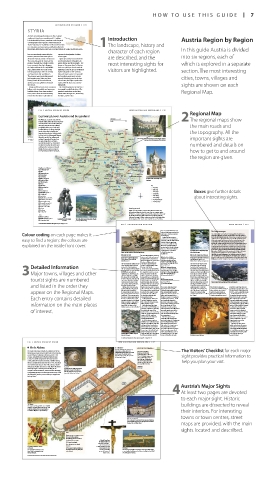
southeast, Styria has a population of 1.2 million. Introduction Austria Region by Region
It is dominated by forests, meadows and vineyards
cover ing some three-quarters of its total area of
16,387 sq km (6,327 sq miles). It is also an area of iron 1The landscape, history and
ore extrac tion and processing, and Erzberg (Iron Ore
Mountain), glittering in every hue of red and brown, is a major tourist attraction. character of each region In this guide Austria is divided
Iron ore was already extracted by the capture the imagination of visitors
Romans, who had named this part of to the region. are described, and the into six regions, each of
Austria the Roman province of Noricum. Styria’s great attractions include the
The mineral shaped the history of this south-facing slopes of Raxalpen, its
province through the centuries, and its gentle climate and its rural idylls – it is most interesting sights for which is explored in a separate
traces survive to this day. Following known as “the green heart” of Austria.
the highs and lows of the early Middle In the west, along its border with the
Ages, Styria fell into the hands of the Salzburger Land, the area is dominated visitors are highlighted. section. The most interesting
Habsburg dynasty in the 13th century by the lofty peaks of the Salzburg
and shared in its fate and fortunes. Alps and Lower Tauern. Here you will
The province was repeatedly ravaged find excellent winter sport centres
by Hungarians and Turks, and, after around Schladming, and at the foot cities, towns, villages and
having staved off the Turkish threat, of Dachstein, the highest peak in the
also became susceptible to attacks by region, with the best cross-country-
the French. skiing trails. sights are shown on each
A legacy of these times are its numerous The Salzkammergut in the north is a
hilltop castle strongholds and imposing stunningly beautiful lake district. The
fortified abbeys. Some have survived province’s main rivers are the Mur, Regional Map.
intact, others have been meticulously which flows through Graz, its tributary
restored to their former splendour to the Mürz, and the Salza.
134 A USTRIA REGION B Y REGION L OWER A USTRIA AND BURGENLAND 135
Regional Map
Exploring Lower Austria and Burgenland
The Wachau, a narrow stretch of the Prague 0 kilometres 20 2The regional maps show
Danube valley, forms the heart of Lower 0 miles 20
Austria, famous for its fertile plains, its
vineyards and picturesque villages. Heidenreichstein Raabs an the main roads and
Formidable fortresses, castles and der Thaya
fortified abbeys rise along the high Jihlawa Brno
banks of the river, including the Gmünd Schrems Groß-Siegharts the topography. All the
imposing Benedictine Abbey in Melk. Laa an der
Further east, the Wienerwald (Vienna Weitra Zellerndorf Thaya
Bad Blumau, an architectural complex based on Franz Hundertwasser’s designs W A L D V I E R T E L Horn Poysdorf 16th-century Teisenhoferhof, with its attractive galleried courtyard, important sights are
Woods) is perfect for walking and
cycling. Burgenland Province has
Steep, terraced vineyards near Gamlitz Zwettl Eggenburg Hohenau now home of the Wachaumuseum, Weissenkirchen
its own unique flora and fauna Hollabrunn Mistelbach
around Neusiedler See. It produces Linz Gerungs Groß Rastenfeld
the finest red wines in Austria and NIEDER- ÖSTERREICH numbered and details on
celebrates the memory of Joseph DÜRNSTEIN Dürnkrut
Haydn, former court musician to WEISSENKIRCHEN KREMS Stockerau Wolkersdorf
the Esterházy family in Eisenstadt. TULLN how to get to and around
SPITZ KORNEUBURG Gänserndorf
STIFT GÖTTWEIG
BURG AGGSTEIN KLOSTERNEUBURG
Linz SCHLOSS HOF
Grein MELK Purkersdorf VIENNA the region are given.
Dona u (Danube)
AMSTETTEN Ybbs ST PÖLTEN Schwechat Donau (Danube) HAINBURG
Haag SCHALLABURG Wilhelmsburg Mödling LAXENBURG Petronell
ROHRAU
NEUHOFEN Purgstall WIENER
AN DER YBBS an der Erlauf
Sights at a Glance Lilienfeld WALD BADEN BRUCK AN DER LEITHA
1 St Pölten pp136–7 WAIDHOFEN Berndorf Ebreichsdorf Neusiedl am See
2 Tulln AN DER YBBS Gaming Podersdorf Györ
3 Klosterneuburg St Aegyd- EISENSTADT Frauenkirchen
4 Korneuburg am-Neuwalde NEUSTADT Rust
WIENER
5 Laxenburg Terz NEUSIEDLER SEE
6 Wiener Neustadt Göstling S C H N E E B E R G Puchberg BURGENLAND The mock-Gothic Franzensburg Castle,
7 Baden bei Wien Bruck an der Mur Neunkirchen Ilmitz Laxenburg
9 Stift Göttweig BURG FORCHTENSTEIN
0 Krems Gloggnitz
w Dürnstein Semmering Aspang Markt Key
e Weissenkirchen Deutschkreutz Motorway
r Spitz Oberpullendorf Major road
t Burg Aggstein Minor road Boxes give further details
y Melk Abbey pp146–7 Mannersdorf Scenic route
u Schallaburg an der Rabnitz Main railway
i Amstetten Pinkafeld about interesting sights.
o Waidhofen an der Ybbs Minor railway
p Neuhofen an der Ybbs Oberwart International border
s Burg Forchtenstein Szombathely Province border
d Neusiedler See pp156–7 Grosspetersdorf
f Eisenstadt pp158–9
g Bruck an der Leitha
h Rohrau Graz Getting Around
j Hainburg Güssing Flights to both provinces depart from Vienna-Schwechat
k Schloss Hof International Airport, which is served by every major airline.
Tours St Pölten is a major railway and road hub, situated on the route
of the Westbahn line, with branch lines to Mariazell, Krems,
8 Wienerwald Tour Tulln and Gaming. St Pölten is also served by the Westautobahn
q Waldviertel Tour pp144–5 Gossiping Women at Herrenplatz The Gothic parish church in Spitz, over looking the Jennersdorf (motorway) and the road connecting Vienna and Salzburg.
a Schneeberg Tour in St Pölten picturesque Wachau valley The entire region is covered by a dense road network.
For hotels and restaurants in this region see p295 and pp316–18 For map symbols see back flap
212 A USTRIA REGION B Y REGION UPPER A USTRIA 213
was named the Hallstatt civili The Salzkammergut
zation. Its influence reached far
Colour coding on each page makes it into France, the Slav countries For centuries, the name Salzkammergut applied only to the area
around the Hallstätter See and Traunsee lakes, and to the towns of
and Hungary.
Bad Ischl, Hallstatt and Gmunden. Salt has been excavated here since
easy to find a region; the colours are Today, Hallstatt treasures prehistoric times, ensuring the longterm wealth and development
can be seen in many Austrian
of the entire region. Salt mines exist in the area to this day. In the
museums, with the bulk of them
second half of the 19th century the area became famous for its
held at Schloss Eggenberg,
explained on the inside front cover. near Graz (see p166). The few therapeutic springs, and with time the term Salzkammergut came to
refer to the entire land of lakes and mountains that is now Austria’s
finds that stayed in Hallstatt
most popular tourist destination. It includes the eastern part of the
are kept in the World Heritage
Museum. The entire Hallstatt Salzburg Alps, with the picturesque mountain ranges of Dachstein
(eastern part), Totes Gebirge (Dead Mountains) and Höllengebirge
region has been declared A mountain stream racing through a gorge (Mountains of Hell). Between the mountains lie 76 lakes, the largest
Bronze-age finds in Hallstatt’s World Heritage Museum a World Heritage Site in the Dachstein range and most famous of which are Traunsee, Mondsee, Attersee,
by UNESCO.
g Hallstatt by the Saints Barbara, patron of j Dachsteinhöhlen salt” straddles three Austrian provinces. The largest part is in Upper
Hallstätter See and Wolfgangsee. For historical reasons, the “land of
Road map D4. * 800. @ £ 4 miners, and Catherine, revered E Salzwelten Hallstatt Road map D4. n Winkl 34, Obertraun Austria, a small area in the south belongs to Styria, whilst almost all of
Lahnstrasse 21. Tel (06132) 200
Wolfgangsee and the St Gilgen resort are part of the Salzburger Land.
by woodcutters. Depicted on
n Seestrasse 99 (06134) 8208. the inner wings are scenes from 2400. Open late Apr–midSep: am Hallstättersee (06131) 351.
∑ hallstatt.net ∑ dachstein-salzkammergut.com
the lives of Mary and Jesus. 9:30am– 4:30pm daily; midSep–
The small town of Hallstatt is one The altar is guarded by the Oct: 9:30am–3pm daily. & = - The caves in the slopes of the
Detailed Information of the loveliest tourist destina statues of two knightly saints, E World Heritage Museum Dachstein range are among
∑ salzwelten.at
George and Florian.
tions in the Salzkammergut.
Austria’s most beautiful and
In the cemetery surrounding
The steep drop of the Dachstein
fascinating natural monuments.
Seestrasse 56. Tel (06134) 828015.
massif provides a scenic backdrop the church stands the Beinhaus, Open Nov–Mar: 11am–3pm Wed– The vast caves, one of the largest
3Major towns, villages and other for the town and adjacent a chapel that serves as a store Sun; Apr, Oct: 10am–4pm daily; May– systems on Earth and millions of
years old, are covered by 500
Sep: 10am–6pm daily. & =
Hallstätter See. The houses are
house for some very bizarre
∑ museum-hallstatt.at
clustered together so tightly
yearold permafrost. After the
objects. This former mortuary
tourist sights are numbered that many are acces sible only now holds some 1,200 human h Gosauseen last Ice Age, under ground waters The much-loved Salzkammergut, land of lakes and mountains
created strange ice mountains,
from the lakeside, while the old
skulls, painted with floral designs
and in many cases inscribed
street runs above the rooftops.
glaciers and frozen waterfalls.
Road map D4. @
The most interesting of these is
Even the local Corpus Christi
with the name, date and cause
and listed in the order they procession is held on the lake, of death of the deceased. Short n Gosau (06136) 8295. the Rieseneishöhle (Giant Ice A little further along, also their size rather than after the
in festive, decorated boats.
age of space in the graveyard
Cave). The caverns in this surreal
had meant that some ten years
Rising above the town on a
underground iceworld are
You cannot truly appreciate
named after King Arthur and
the unique charms of the
after a funeral, when a body had
prehistoric mammal. These caves
in a limestone wall of Dachstein,
rocky headland is the pagoda
appear on the Regional Maps. like roof of the Pfarrkirche. decomposed, the remains were Salzkammergut without visiting the Celtic heroes, Parsifal and is the entrance to a second do not have ice formations, but
Its stepped dome dates from a
moved to the chapel to make
there is a spectacular light show.
system of caves, known as
this outstandingly beautiful
Tristan. The most arresting
Mammuthöhle (Mammoth
cavern formation is the socalled
room for the next coffin to
Both networks of caves can
later period, but the church was
Alpine area. The Gosauseen are
three small mountain lakes –
be buried, resulting in this
built in the 15th century and to
be reached via paths starting
Ice Chapel.
Caves), so named because of
Each entry contains detailed this day contains many original unusual depository. Vorderer Gosausee, Gosaulacke from the first cablecar station.
A short distance below the
and Hinterer Gosausee – both
features, including the carved
The sightseeing route leads
are beautifully situated in
through a labyrinthine network
Catholic Pfarrkirche stands a
wooden altarpiece of the Virgin
information on the main places Mary, sometimes compared to NeoGothic Protestant church, limestone rocks intercut with of tunnels, gorges and chambers
deep gorges. Vorderer Gosausee
with a slender steeple.
Pacher’s altar in St Wolfgang
that stretch over 44 km (27 miles),
lies at an altitude of 933 m
(see p209). The figure of the
with a 1,200 m (4,000 ft) change
Vertically above the town,
about 500 m (1,640 ft) higher, is
in altitude. Individual caverns
(3,061 ft). An undemanding
Madonna at its centre is flanked
of interest. Salzwelten Hallstatt, probably walk around the lake will reward have been given evocative
names such as the Realm of
you with superb views of the
the oldest salt mine in the
surrounding mountains and
world, which can be reached by
Shadows or Midnight Cathedral.
cable car. Salt was mined here as over the Dachstein range with Also worth seeing is a third
early as 3,000 BC and then its many glaciers. cave, Koppenbrüller höhle,
transported to the Baltic Sea The most picturesque which has a giant water source
and the Mediterranean. mountain, with zigzag peaks and is considered to be the
In 1846, a large cemetery and a sheer drop, is Gosaukamm largest water cave in the
yielding some 2,000 graves was (2,459 m/8,068 ft high). This is Dachstein massif.
uncovered in Hallstatt. Rich bur the easternmost part of the All caves are open to the
ial objects dated mainly from Alps where the snow stays on public only during the spring
the Iron Age but some dated the ground all year round. and summer seasons (May to
even further back in time, to the The road to Hinterer Gosausee Oct; Koppenbrüllerhöhle May
Bronze Age. The Hallstatt finds climbs steeply among thick to Sep). When visiting the caves,
Painted skulls in the Beinhaus chapel of proved so important archae forest. From this lake, 1,154 m especially the ice caves, make
(3,786 ft) high, you can climb
sure you take plenty of
ologically that the Celtic culture
Hallstatt’s Pfarrkirche of that period (800–400 BC) some of the adjacent peaks. Dachstein ice caves in Obertraun warm clothing.
For hotels and restaurants in this region see pp296–7 and pp320–21
146 A USTRIA REGION B Y REGION L OWER A USTRIA AND BURGENLAND 147
y Melk Abbey . Stiftskirche VISITORS’ CHECKLIST
The splendid Baroque monastery The Visitors’ Checklist for each major
The town and abbey of Melk, the original seat of the church has a ceiling fresco by Practical Information
Johann Michael Rottmayr. The main
Babenbergs, tower above the left bank of the Danube, altar features the figures of the Road map F3. * 5,000.
some 60 km (37 miles) west of Vienna. In the 11th church’s patron saints, the apostles n Kremser Strasse 5, (02752) sight provides practical information to
555-232. _ Melker Sommerspiele
century, Leopold II invited the Benedictines from St Peter and St Paul. (Jul, Aug). Melk Abbey: Open
Lambach to Melk and granted them land and the May–Sep: 9am–5:30pm; Apr &
castle, which the monks turned into a fortified abbey. Oct: 9am–4:30pm. & 8 by help you plan your visit.
Almost completely destroyed by fire in 1297, the abbey appoint ment. Nov–Mar: guided
tours only. ∑ stiftmelk.at
was rebuilt many times. In the 16th century, it had to
withstand a Turkish invasion. In 1702, Abbot Berthold Stairwell Transport
Dietmayr began a thorough remodelling of the A spiral staircase with ornamental
@ £ g
complex. Jakob Prandtauer, Johann Michael Rottmayr, balustrade connects the library
with the Stiftskirche, the monastery
Joseph Munggenast and other renowned artists of the church of St Peter and St Paul.
day helped to give the present abbey its magnificent
Baroque form.
Austria’s Major Sights
4At least two pages are devoted
to each major sight. Historic
. Library buildings are dissected to reveal
The impressive library holds some 100,000
volumes, including 2,000 manuscripts and
1,600 incunabula. It is decorated with a
beautiful ceiling fresco by Paul Troger. their interiors. For interesting
towns or town centres, street
Prelates’ Courtyard
The courtyard is surrounded by imposing buildings
crowned with statues of the prophets and frescoes
showing the cardinal virtues. maps are provided, with the main
sights located and described.
KEY
1 Marble Hall, a magnificent room
decorated with a painting
by Paul Troger, was once used for
receptions and ceremonies. . Melk Crucifixes
2 Convent courtyard The abbey holds two
3 17th-century two-tiered important crucifixes –
one is Romanesque
Crowning with the Crown fountain (c.1200, shown here), the
of Thorns 4 The grand staircase leading to other from the 14th The View
This powerful painting by Jörg the imperial apartments, with putti century, containing Austria’s most magnificent Baroque monastery, Melk Abbey
Breu (1502) is exhibited in the and sculptures. gems and a piece of is a vast yellow building perched dramatically on a high bluff
Abbey Museum. Christ’s cross. overlooking the Danube.
For hotels and restaurants in this region see p295 and pp316–18
006-007_EW_Austria.indd 7 12/09/17 3:01 pm

